How Guthy Renker Made Acne Conversation
Before social media told you to love your skin, Proactiv told you it was okay to hate it — and that you weren’t alone. For an entire generation, those late-night infomercials weren’t really about benzoyl peroxide or three-step systems. They were about a girl in the back of her high school classroom pulling her hair over her face, a boy canceling plans because of what he saw in the mirror that morning.
Proactiv was the first time many of us heard someone famous — someone beautiful — admit they had the same secret we were hiding under foundation and shame. It wasn’t a skincare brand. It was a permission slip. A quiet revolution broadcast at midnight, reaching teenagers in their bedrooms who finally felt seen by something flickering on a television screen. Acne had always been whispered about, managed in private, treated like a character flaw rather than a biological reality. Proactiv dragged it into the open — and in doing so, started a conversation that an entire generation desperately needed to have.
The Empire: Guthy-Renker’s Proactiv at Its Peak
Proactiv was developed by dermatologists Rodan and Fields in 1995 and launched by Guthy-Renker, a California-based direct marketing company. At its peak, sales amounted to $800 million a year, with a media budget of nearly $200 million and $12–15 million annually spent on celebrity fees. By 2012, Guthy-Renker’s full portfolio was making $1.8 billion a year, with Proactiv as the engine and infomercials as it’s primary marketing vehicle.
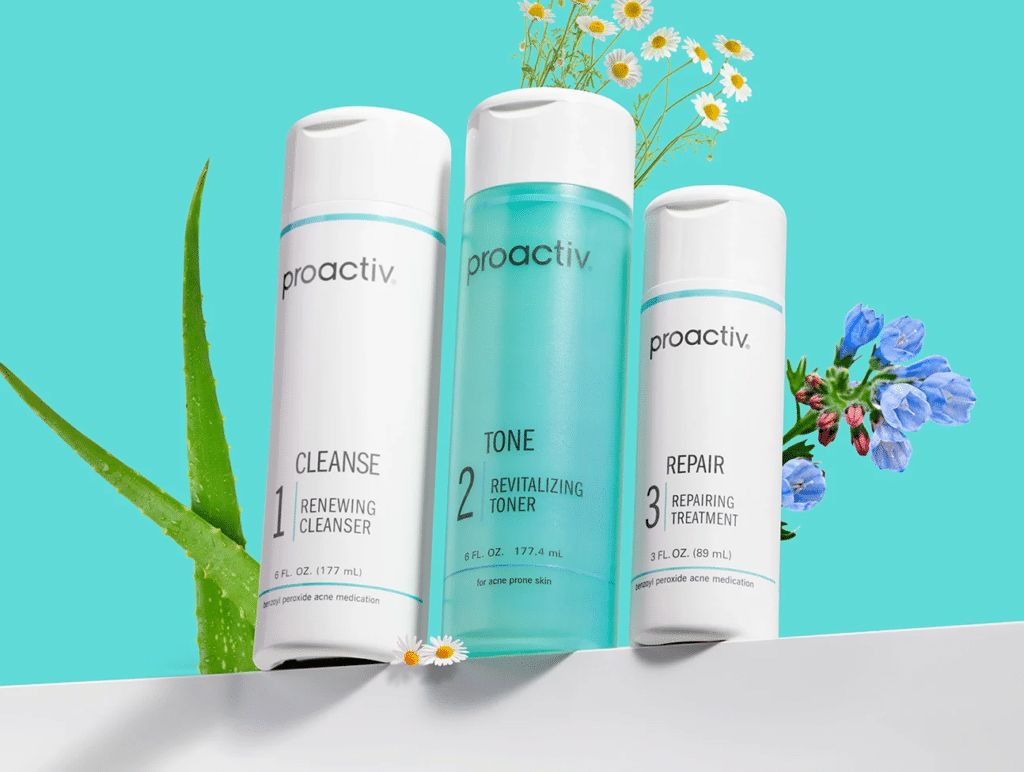
The model was genius for its era — a subscription-based continuity program powered by long-form infomercials, emotional celebrity confessionals (Britney, Bieber, Katy Perry, Jessica Simpson), and late-night infomercials that owned living rooms.
The Amazon Pivot (~2015)
Proactiv joined Amazon in early 2015, having been a brand focused almost entirely on direct marketing through infomercials, mailings, and email. A Guthy-Renker VP acknowledged at the time that they had to be careful “not to cannibalize” their own subscription channel — so it was, in their words, “walk before I run.” That tension — between protecting their subscription model and expanding retail reach — was a signal of the identity crisis to come.
The Sell-Off Begins (2016)
In 2016, Guthy-Renker entered a joint venture with Nestlé Skin Health, which acquired a majority stake in its European business. The company was renamed The Proactiv Company and all other product lines were discontinued. Then in 2019, Nestlé exited the skin health business entirely and sold Galderma and Proactiv to a private equity consortium. That’s three ownership changes in just a few years — Guthy-Renker → Nestlé → PE consortium (Galderma) → Taro Pharmaceutical.
The Rebrand Nobody Asked For (2022)
On February 22, 2022, Alchemee was acquired by Taro Pharmaceutical Industries for $99.3 million. To put that in perspective — a brand that was valued at potentially $2 billion in 2016 sale discussions sold six years later for roughly $99 million. That’s a staggering collapse in perceived value.
The company rebranded from Proactiv to Alchemee, pivoting beyond acne into hyperpigmentation, psoriasis, eczema, and dermatitis. The original brand identity — built over 25 years — was essentially abandoned.
The Competitive Erosion
By the time Proactiv arrived on Ulta shelves in 2016, it was hardly the only player in the acne market. Countless brands were incorporating key ingredients like benzoyl peroxide, sulfur, and salicylic acid. New brands like Drunk Elephant and The Ordinary became hits. And Proactiv’s once-distinguishing muscle — big celebrity endorsements — grew weaker in the age of Instagram, when seemingly any brand could sponsor a Kardashian.
Competitors like Neutrogena, Clean & Clear, and later upstarts like Curology, CeraVe, and The Ordinary chipped away at its market share. Meanwhile, Gen-Z culture flipped the script on acne — embracing it rather than hiding it, making the shame-and-solution emotional hook that built Proactiv feel dated.
The Final Blow (2025)
In 2025, Proactiv products were caught up in a national recall after benzene, a known carcinogen, was detected in certain lots of its acne creams. A brand that had once promised to heal your skin was now associated with a chemical that could potentially harm health. The trust Proactiv had built over decades wasn’t undone overnight, but it was undeniably shaken.
Conclusion
Proactiv.com is still live and operating as an e-commerce site run by Alchemee LLC, now owned by Taro Pharmaceuticals USA Inc., with Proactiv as a registered trademark of Taro. So the brand exists, the products ship.
It’s a trademark owned by a pharmaceutical company, sold through a website, generating the kind of revenue a mid-size regional brand might. The celebrity campaigns are gone. The infomercials are gone. The founders left long ago to build Rodan + Fields. The subscription army that once numbered in the millions has largely moved on to CeraVe, The Ordinary, or Curology.
It’s the brand equivalent of a pulse without consciousness. Alive on paper, absent in spirit.
Next Read: ">Lean how Verity Marketing 2.5X a 30-year old firm in 5-years>>">>">Lean how Verity Marketing 2.5X a 30-year old firm in 5-years>>