


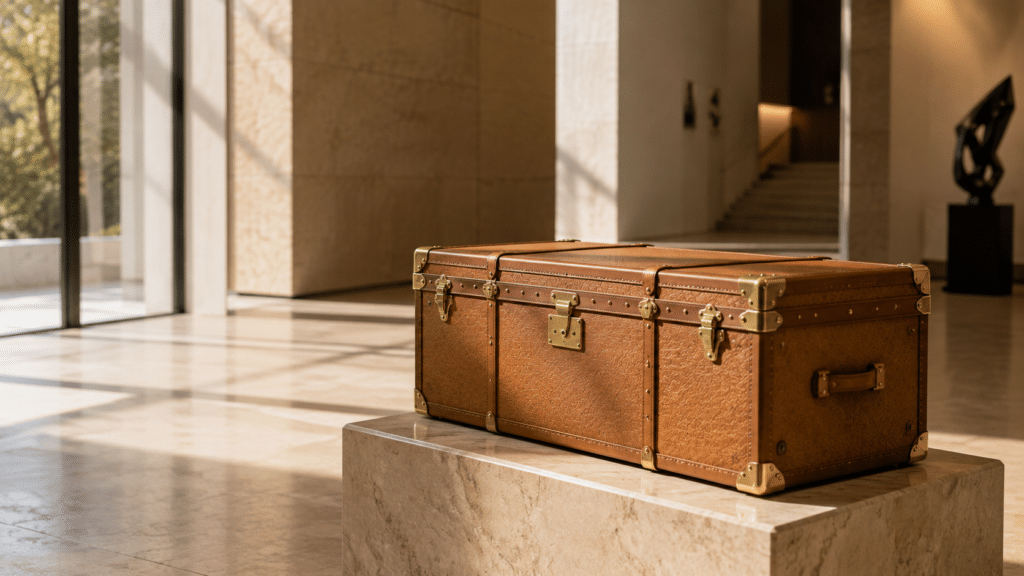
Spain lifted the FIFA World Cup trophy on July 19, 2026, at MetLife Stadium in New Jersey. But 2.3 billion people also watched something else: an 18-carat gold trophy emerging from Monogram canvas, hand-painted with golden “V”s, carried onto the pitch in a bespoke Louis Vuitton trunk. It was the fifth consecutive World Cup where Louis Vuitton designed the official trophy case — and arguably the most strategically sophisticated luxury marketing move of the year. This article breaks down exactly why it worked, what it means for luxury brand strategy, and what every marketer can learn from a brand that didn’t buy visibility during the tournament. They bought the moment.
The 47 Seconds That Reached 2.3 Billion People
Before Spain and Argentina took the field for the FIFA World Cup 2026 final, the trophy made an entrance of its own.
Carried onto the pitch in a custom Louis Vuitton trunk, it was unveiled by Spanish tennis champion Carlos Alcaraz and South Korean actor and model Hoyeon, both Louis Vuitton ambassadors. They were joined by Andrés Iniesta, a member of Spain’s 2010 World Cup-winning team, and Mario Kempes, who helped Argentina claim the title in 1978. V Magazine
The 2026 FIFA World Cup Trophy Trunk was brought onto the pitch for the finals ceremony and became part of the music and entertainment programs when football’s greatest achievement was celebrated.
The trunk opened. The trophy was revealed. And Louis Vuitton owned the most emotionally charged moment in global sport.
Not a jersey logo. Not a stadium naming right. Not an athlete endorsement deal.
The frame of the pause — the 47 seconds when collective ambition becomes triumph, when the most watched object in sport emerges into the light.
That’s what Louis Vuitton bought. And it’s worth understanding exactly how they pulled it off.
Why This Is the Fifth World Cup — And Why That Number Matters
The 2026 edition marks the fifth consecutive FIFA World Cup for which Louis Vuitton has created the official Trophy Trunk, extending a collaboration that began with the 2010 tournament in South Africa.
Five consecutive World Cups. Four years between each one. That’s a 16-year investment in a single strategic position.
Most brand partnerships think in campaign cycles. Louis Vuitton thought in decades. And that long-term commitment is precisely what transformed a clever marketing move into an institutional fact.
Louis Vuitton’s relationship with sport extends far beyond football. Since 2010, the house has created the World Cup trophy’s traveling case, while its trunks have also appeared at the America’s Cup, the Davis Cup, Roland Garros, Formula 1, the Rugby World Cup, the NBA Finals, the Ballon d’Or, and the Paris 2024 Olympic and Paralympic Games. V Magazine
The pattern compounds. Across sports, across decades, across cultures. “Victory travels in Louis Vuitton” stops being marketing copy and becomes institutional fact — the kind of association that lives in the cultural subconscious rather than the conscious advertising recall.
This is the difference between a campaign and a strategy. Campaigns create moments. Strategies create meaning.
The Craft at the Center of Everything
What makes the Louis Vuitton World Cup strategy genuinely sophisticated — and genuinely different from most luxury brand sports partnerships — is that it isn’t borrowed equity. It’s heritage activated at scale.
The trunk was handcrafted at Louis Vuitton’s historic workshops in Asnières-sur-Seine, outside Paris. Covered in the house’s signature Monogram canvas, it featured two hand-painted golden V panels representing both victory and Vuitton.
Handcrafted in the historic Asnières-sur-Seine workshops, the custom trunk is wrapped in LV’s signature Monogram canvas, featuring hand-painted gold panels that form a hard-to-miss “V” for both Victory and Vuitton. Refinery29
The Asnières workshops have been making trunks since the 1850s. The same techniques. The same brass hardware. The same leather lozines. The same craft that built cases for 19th-century explorers crossing continents is the same craft that now protects the most watched object in sport.
That continuity is not incidental — it’s the entire point. When Louis Vuitton carries the World Cup trophy, they’re not attaching themselves to football’s prestige. They’re demonstrating that their core competency — building things worth protecting — is exactly what the moment requires.
Louis Vuitton CEO and Chairman Pietro Beccari emphasized the shared commitment to excellence: “For over a decade, Louis Vuitton and FIFA have shared an unwavering commitment to excellence, bound by a shared belief in sport’s power to inspire and bring people together.”
FIFA chief business officer Romy Gai added: “The Official Trophy is the most coveted prize in world football, and it is only fitting that it is carried in a Louis Vuitton trunk.”
Both quotes are doing real work here. Beccari frames it as a values alignment — excellence meeting excellence. Gai frames it as inevitability — of course the world’s most coveted trophy travels in Louis Vuitton. That’s not a partnership announcement. That’s an institutional endorsement.
The Architecture of the Moment
The trophy presentation at the 2026 World Cup final wasn’t just a product placement. It was a precisely engineered ceremony within a ceremony.
The trunk did more than transport the trophy. It framed its arrival, turning the opening of a case into part of the ceremony and placing Vuitton’s visual codes within one of sport’s most widely broadcast moments.
Think about what that means structurally. FIFA’s opening ceremony, which included Jennifer Hudson performing the U.S. national anthem and a speech by Tom Cruise, was the context. Within that context, Louis Vuitton owned a specific moment — not as an advertisement but as part of the ritual itself.
The trunk opening isn’t a commercial break. It’s part of the event. Audiences aren’t watching an ad between the ceremony and the match. They’re watching the ceremony, and Louis Vuitton is woven into it.
This is the distinction between traditional sponsorship and what Louis Vuitton has built. Traditional sponsorship lives in the noise — logo saturation, presence without meaning. Louis Vuitton owns the signal — the specific moment when the noise stops and the emotion peaks.
When emotion peaks globally. When the trophy gets revealed. When 2.3 billion people hold their breath simultaneously.
That 47 seconds belongs to Louis Vuitton.
The Commercial Layer: Limited Editions and the Democratization of Ritual
The World Cup trunk isn’t just a brand moment. It’s a commercial ecosystem.
For 2026, the house expanded its role as an official FIFA supplier and branded licensee and introduced three limited-edition trunks inspired by the trophy case, including two watch trunks and a Malle Courrier.
The strategic logic is elegant. The trophy trunk creates an emotional association between Louis Vuitton and ultimate victory at a global scale. The limited-edition consumer pieces allow individuals to participate in that association at a personal scale.
You’re not buying luggage. You’re buying participation in the ritual that Spain’s players experienced on July 19, 2026, at MetLife Stadium.
That’s a fundamentally different commercial proposition than “buy this bag because it’s well-made” or “buy this bag because a celebrity carries it.” You’re buying a piece of a ceremony. A connection to a moment that 2.3 billion people witnessed simultaneously.
Limited editions tied to the World Cup carry a specific emotional charge that standard catalog pieces can’t replicate. The personalization element — initials on a trunk inspired by the trophy case — transforms a luxury purchase into something closer to a memento of the moment itself.
Why This Strategy Is Even Smarter Given LVMH’s 2026 Context
The Louis Vuitton World Cup strategy looks even more sophisticated when you understand the business context in which it was deployed.
This collaboration is strategic for Louis Vuitton, which faces recent sales declines and a drop in brand valuation. The luxury brand aims to shift its image from mere status to deeper cultural connection and belonging, aligning with affluent consumers’ evolving desires for shared values and emotional understanding. Forbes
When luxury demand softens — when the status-signaling function of luxury goods becomes less compelling in a particular economic moment — the brands that survive are the ones with the deepest cultural roots. Not just the most recognizable logos, but the most meaningful associations.
Louis Vuitton’s World Cup play is precisely calibrated for this moment. It doesn’t sell product directly. It reinforces the cultural position that makes the product worth wanting. It reminds 2.3 billion people that Louis Vuitton is the house that protects the things that matter most. The things worth protecting. The things worth waiting for.
Louis Vuitton has a long history of crafting trophy trunks for major sporting events, leveraging these high-profile moments to associate its brand with ultimate victory and gain significant cultural capital and earned media, rather than focusing on immediate sales. Forbes
Cultural capital is the most durable form of brand equity. It doesn’t fluctuate with quarterly results. It doesn’t disappear when a trend shifts. It compounds across years and decades — which is exactly what 16 years of World Cup trophy trunks has done for Louis Vuitton.
The mental link between ultimate victory and the LV monogram gets reinforced across 2+ billion viewers at every tournament. That’s pricing power. That’s next-generation desirability. That’s the kind of brand equity that advertising budgets cannot replicate.
The Competitive Analysis: What Other Luxury Brands Can’t Do
It’s worth asking: could another luxury brand replicate this strategy?
The honest answer is almost certainly not — at least not with this particular execution.
The Louis Vuitton World Cup strategy works because it’s not a sponsorship grafted onto a brand. It’s a demonstration of the brand’s core competency in the highest-stakes context imaginable. Louis Vuitton makes trunks. They’ve been making trunks since 1854. The World Cup trophy case isn’t a stretch — it’s the most logical application of what they’ve always done, elevated to a global stage.
A fashion brand that doesn’t make trunks couldn’t do this authentically. A watchmaker, a jeweler, or a perfume house couldn’t frame their core product as the natural vessel for football’s greatest prize.
The authenticity gap — the distance between what a brand actually does and what it’s claiming in a sponsorship context — is what makes most luxury sports partnerships feel forced. Louis Vuitton has no authenticity gap here. They make the best trunks in the world. Of course the World Cup trophy travels in one.
That’s the strategic moat. It took 16 years to build. It cannot be replicated overnight.
Industry Implications: What This Reframes for Brand Strategy
Sponsorship rights should be evaluated by emotional position, not visibility metrics. The traditional sponsorship framework measures impressions, reach, and logo visibility. Louis Vuitton’s framework measures something different: does this put our brand at the exact moment when emotion peaks? That’s a fundamentally different evaluation criterion — and it produces fundamentally different results.
Heritage is only valuable if it’s activated authentically. Many luxury brands have heritage. Few activate it in ways that feel genuinely relevant rather than nostalgic. Louis Vuitton found the perfect context: a moment where the need for protection, craftsmanship, and ceremony converged simultaneously, and their heritage answered all three.
The ritual moment is more valuable than the broadcast moment. A 30-second ad during the World Cup final reaches the same audience. It costs significantly less. And it produces a fraction of the cultural impact — because it’s an interruption, not a ceremony. Brands that can identify and own the ritual moments in their category will always outperform brands that buy broadcast moments.
Repetition transforms association into fact. Five consecutive World Cups. The same trunk. The same moment. The same association. What started as a clever brand move in 2010 is now an institutional expectation. When people think about how the World Cup trophy arrives on the pitch, they think of a Louis Vuitton trunk. That’s not advertising recall. That’s cultural memory.
Lessons for Leaders
Find the ceremony, not the audience. Every industry has ritual moments — the instant when ambition crystallizes into achievement, when the outcome is revealed, when the stakes are highest. Most leaders look for audiences. The most sophisticated brand strategists look for ceremonies. The ceremony is where meaning lives.
Play the long game on cultural position. The Louis Vuitton World Cup strategy required 16 years of commitment before it became an institutional fact. Leaders who need to see quarterly brand equity returns from cultural investments will never build what Louis Vuitton has built. Cultural capital requires patience.
Make sure the brand belongs in the moment. The most important question before any cultural partnership: does our brand genuinely belong here? Not “can we afford to be here” or “would it reach the right audience.” Does the brand’s core identity have an authentic reason to be part of this specific moment? If the answer requires creative reasoning, it’s probably not authentic enough.
Lessons for Marketers
Own the frame, not just the space. Most sponsorships buy space — a logo here, a banner there. Louis Vuitton bought the frame — the specific visual and emotional context in which the most important moment occurs. Framing is more powerful than presence because it shapes how the audience interprets everything that follows.
Craft is the most credible form of brand communication. No advertisement could have communicated what the Louis Vuitton trunk communicates by existing on that pitch. The trunk is the message. The craftsmanship is the proof point. Marketers who can demonstrate rather than claim will always outperform those who rely on assertion alone.
Earned media compounds when the moment is genuinely remarkable. The World Cup trophy trunk generated press coverage across fashion, sports, business, and culture publications simultaneously — not because Louis Vuitton pitched it aggressively but because it was genuinely remarkable. Design the moment to be worth covering, and the coverage follows.
Lessons for Operators
Consistency of execution is what builds institutional associations. The same workshops. The same techniques. The same Monogram canvas. The same moment at the same tournament. Five times. That operational consistency is what transforms a brand partnership into a cultural institution. Consistency at the execution level is what makes the strategy work at the brand level.
The commercial layer should feel like an extension, not an afterthought. The limited-edition consumer trunks inspired by the trophy case feel like a natural continuation of the World Cup moment — not a commercial cash-in. The sequencing matters: establish the cultural moment first, then create the commercial pathway that allows individuals to participate in it.
Access and exclusivity can coexist. 2.3 billion people saw the trunk open. 200 people can own the limited-edition version. The mass visibility creates desire. The exclusivity makes the desire feel worth acting on. Operators who can calibrate the tension between access and exclusivity create the conditions for genuine luxury desirability.
The Framework: Finding Your Trophy Presentation Moment
You don’t have a World Cup. But every industry has a ceremony — a specific moment when your customer’s ambition crystallizes into achievement. Here’s how to find and own it.
Step 1 — Map the emotional journey. Trace your customer’s path from aspiration to achievement. Where does the emotion peak? Where does the outcome become visible? Where does the private effort become public recognition? That’s your ceremony.
Step 2 — Identify who owns that moment. In most industries, nobody owns the ritual moment. The ceremony exists — the award presentation, the closing bell, the ribbon cutting, the product launch — but no brand has made itself indispensable to staging it. That’s the opportunity.
Step 3 — Ask whether your brand genuinely belongs there. The Louis Vuitton strategy works because their core competency — protecting precious things — is exactly what the moment requires. Your brand needs an authentic reason to be part of the ceremony. If the connection requires explanation, it’s probably not authentic enough.
Step 4 — Commit to repetition. One appearance at a ceremony is a guest appearance. Five appearances is an institution. The power of the Louis Vuitton strategy comes from 16 years of showing up at the same moment with the same craft and the same commitment. Budget for the long game.
Step 5 — Build the commercial pathway. Once the ceremonial association is established, create products or experiences that allow your customers to participate in the ritual at a personal scale. The limited-edition trunk isn’t a separate commercial initiative — it’s the personal expression of the institutional moment.
Future Implications
The 2026 World Cup trophy trunk represents the maturation of a strategy that Louis Vuitton has been building since 2010. The question for the next four years — ahead of the 2030 World Cup — is whether any other brand in any other category figures out what Louis Vuitton figured out.
The principle is transferable. Find the ceremony. Own the frame. Activate heritage authentically. Repeat until the association becomes institutional.
The brands that will define the next decade of luxury marketing won’t be the ones with the biggest advertising budgets or the most recognizable logos. They’ll be the ones that find their equivalent of the trophy trunk — the specific moment when their core competency meets the world’s peak emotional attention — and show up there, consistently, for long enough that the association becomes fact.
Most brands try to attach themselves to excellence. Louis Vuitton made themselves the vessel through which excellence is revealed.
The difference is everything.
Frequently Answered Questions
Why does Louis Vuitton design the FIFA World Cup trophy trunk?
Louis Vuitton has unveiled its bespoke Trophy Trunk for the FIFA World Cup 2026, continuing a partnership that has become one of football’s most recognisable ceremonial traditions. The French luxury house presents the handcrafted case that transports and displays football’s biggest prize before the final. The partnership began in 2010 and has continued through every World Cup since. Storyboard18
Who carried the Louis Vuitton trunk at the 2026 World Cup final?
Carlos Alcaraz and South Korean actor and model Hoyeon, both Louis Vuitton ambassadors, carried the trunk onto the pitch. They were joined by Andrés Iniesta and Mario Kempes, former World Cup winners representing Spain and Argentina respectively. V Magazine
Where is the Louis Vuitton World Cup trunk made?
The fifth such trunk, in as many editions of the World Cup, is made by the Maison’s artisans in its Asnières-sur-Seine workshops near Paris. The same workshops have been crafting Louis Vuitton trunks since the 1850s. Yanko Design
What does the golden “V” on the 2026 trunk represent?
The 2026 FIFA World Cup Trophy Trunk comes enclosed in an all-LV Monogram canvas cover and features a pair of front panels adorned with a golden “V,” which stands for both Vuitton and Victory. Yanko Design
Did Louis Vuitton release consumer products connected to the World Cup trunk?
For 2026, the house expanded its role as an official FIFA supplier and branded licensee and introduced three limited-edition trunks inspired by the trophy case, including two watch trunks and a Malle Courrier. WWD
What other sporting events has Louis Vuitton created trunks for?
Louis Vuitton’s relationship with sport extends far beyond football. Its trunks have appeared at the America’s Cup, the Davis Cup, Roland Garros, Formula 1, the Rugby World Cup, the NBA Finals, the Ballon d’Or, and the Paris 2024 Olympic and Paralympic Games. V Magazine
Why is the Louis Vuitton World Cup strategy considered smart luxury marketing?
Because it doesn’t borrow someone else’s prestige — it deploys Louis Vuitton’s own heritage in the most logical possible context. A brand that has been making trunks since 1854 protecting the world’s most coveted trophy is a demonstration of core competency, not a sponsorship stretch.
How does the Louis Vuitton trophy trunk strategy relate to LVMH’s business challenges?
This collaboration is strategic for Louis Vuitton, which faces recent sales declines and a drop in brand valuation. The luxury brand aims to shift its image from mere status to deeper cultural connection and belonging, aligning with affluent consumers’ evolving desires for shared values and emotional understanding. Forbes
What did Pietro Beccari say about the Louis Vuitton FIFA partnership?
Louis Vuitton CEO and Chairman Pietro Beccari stated: “For over a decade, Louis Vuitton and FIFA have shared an unwavering commitment to excellence, bound by a shared belief in sport’s power to inspire and bring people together.” LatestLY
What is the broader lesson for brands from the Louis Vuitton World Cup strategy?
Stop buying visibility in the noise. Find the ritual moment in your market — the instant when your customer’s ambition crystallizes into achievement — and make yourself indispensable to staging it. Not through sponsorship. Through craft that serves the ceremony.
Louis Vuitton has unveiled its bespoke Trophy Trunk for the FIFA World Cup 2026, continuing a partnership that has become one of football’s most recognisable ceremonial traditions. The French luxury house presents the handcrafted case that transports and displays football’s biggest prize before the final. The partnership began in 2010 and has continued through every World Cup since. Storyboard18
Carlos Alcaraz and South Korean actor and model Hoyeon, both Louis Vuitton ambassadors, carried the trunk onto the pitch. They were joined by Andrés Iniesta and Mario Kempes, former World Cup winners representing Spain and Argentina respectively. V Magazine
The fifth such trunk, in as many editions of the World Cup, is made by the Maison’s artisans in its Asnières-sur-Seine workshops near Paris. The same workshops have been crafting Louis Vuitton trunks since the 1850s. Yanko Design
The 2026 FIFA World Cup Trophy Trunk comes enclosed in an all-LV Monogram canvas cover and features a pair of front panels adorned with a golden “V,” which stands for both Vuitton and Victory. Yanko Design
For 2026, the house expanded its role as an official FIFA supplier and branded licensee and introduced three limited-edition trunks inspired by the trophy case, including two watch trunks and a Malle Courrier. WWD
Louis Vuitton’s relationship with sport extends far beyond football. Its trunks have appeared at the America’s Cup, the Davis Cup, Roland Garros, Formula 1, the Rugby World Cup, the NBA Finals, the Ballon d’Or, and the Paris 2024 Olympic and Paralympic Games. V Magazine
Because it doesn’t borrow someone else’s prestige — it deploys Louis Vuitton’s own heritage in the most logical possible context. A brand that has been making trunks since 1854 protecting the world’s most coveted trophy is a demonstration of core competency, not a sponsorship stretch.
This collaboration is strategic for Louis Vuitton, which faces recent sales declines and a drop in brand valuation. The luxury brand aims to shift its image from mere status to deeper cultural connection and belonging, aligning with affluent consumers’ evolving desires for shared values and emotional understanding. Forbes
Louis Vuitton CEO and Chairman Pietro Beccari stated: “For over a decade, Louis Vuitton and FIFA have shared an unwavering commitment to excellence, bound by a shared belief in sport’s power to inspire and bring people together.” LatestLY
Stop buying visibility in the noise. Find the ritual moment in your market — the instant when your customer’s ambition crystallizes into achievement — and make yourself indispensable to staging it. Not through sponsorship. Through craft that serves the ceremony.