Most brands treat major sporting tournaments as awareness plays. Visa treated the 2026 FIFA World Cup as infrastructure. Their “Tap In” campaign — built around the double meaning of football’s easiest goal and contactless payment technology — didn’t just generate impressions. It generated measurable commercial results: cross-border Visa transactions in host cities jumped nearly 20% year-over-year, tap-to-pay transactions rose 12%, card-present transactions spiked 20% on match days, and transit taps in US host cities peaked at 40% growth. This is the full breakdown of how one word, two meanings, and zero explanation needed produced one of the most commercially effective sponsorship campaigns of the 2026 World Cup — and what every brand can learn from it.
The Insight That Made Everything Work
A tap-in goal is football’s most unglamorous moment. No acrobatics. No long-range strike. No individual brilliance. The ball arrives at the far post, a player redirects it from close range into the net, and the scoreboard changes.
It is, by definition, the simplest thing you can do in football.
Visa made it the centerpiece of their entire World Cup campaign. And in doing so, produced one of the most commercially effective sponsorship activations the tournament has ever seen.
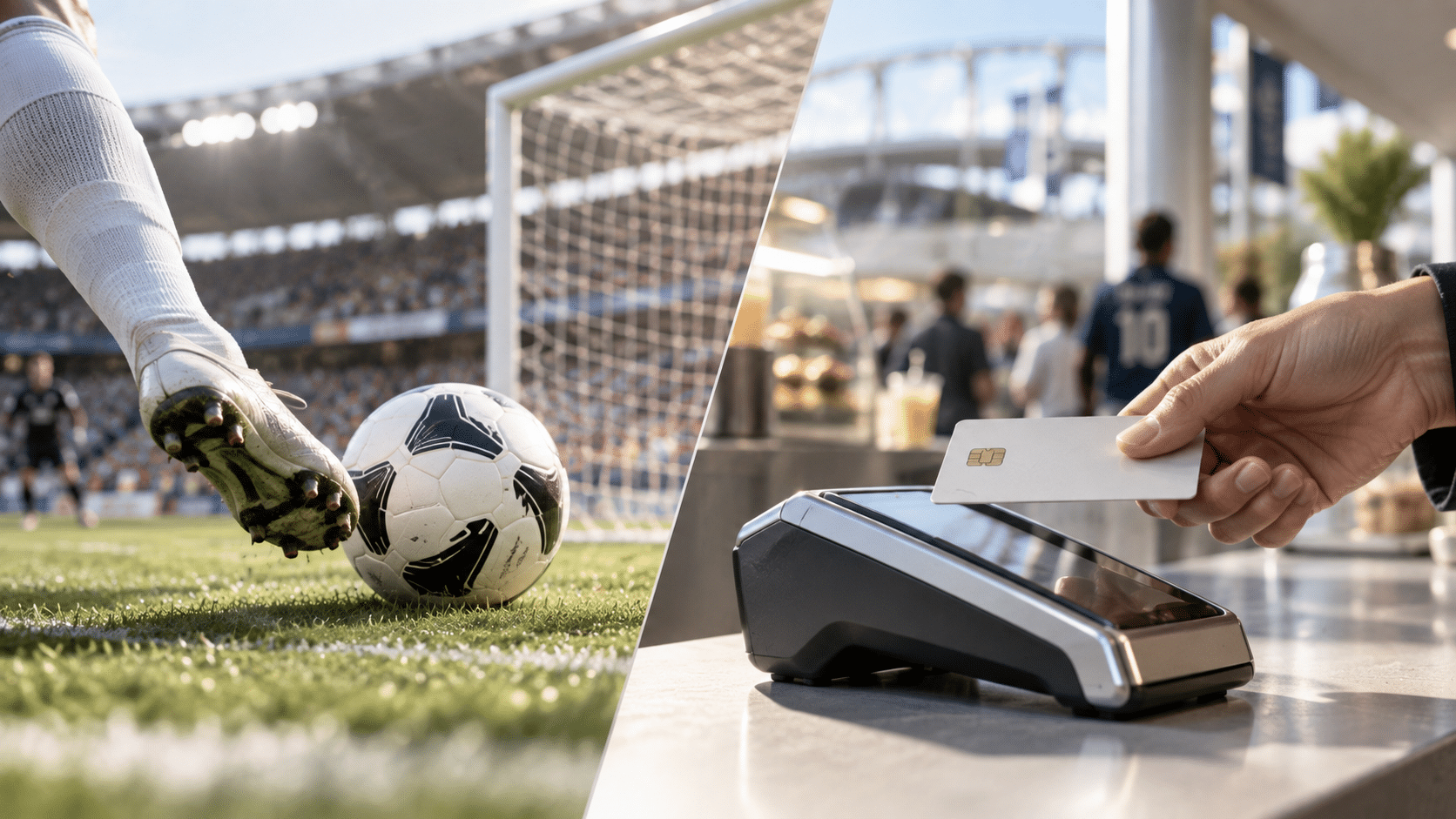
The insight was deceptively simple: a tap-in goal and a contactless card tap are the same word. One word. Two meanings. Zero explanation needed.
“Tap In” has double meaning: it’s a colloquialism for contactless payments and a soccer term for a goal scored from close range.
That’s not wordplay. That’s a strategic insight that only becomes available to a brand that has spent years deeply embedded in football culture. Visa has been a World Cup sponsor since 2007. As the Worldwide Payment Technology Partner of the FIFA World Cup 2026, Visa is using the tournament to show how sponsorships can be a part of what fans actually do.
The “Tap In” campaign is the fullest expression of that philosophy — and the clearest recent example of what happens when a brand finds an insight so natural that it feels inevitable rather than constructed.
The Film: Simple, Funny, and Built for Sharing
The 60-second spot opens on Ted Lasso star and co-creator Jason Sudeikis watching soccer, specifically Spanish forward Lamine Yamal scoring a tap-in goal. The move inspires Sudeikis to tap his Visa card on a script, which turns into tickets. He turns a bag of trash into a bag of soccer balls, a hockey net into a soccer net, and so on, as he travels across host countries.
The campaign is led by Jason Sudeikis, whose appearance clearly evokes the atmosphere and emotional tone of Ted Lasso, even though he does not formally appear as the character himself.
The casting decision is precise. Sudeikis isn’t just a famous face — he’s a specific cultural signal. Ted Lasso is a show about football that made non-football fans care about football. It bridged two audiences: existing football fans who recognized the authenticity of the depiction, and new fans who were drawn in by the emotional storytelling. Casting Sudeikis without formally invoking Ted Lasso is a masterstroke — it gets all the cultural association without any of the licensing complexity.
He is joined in the Tap In campaign by some of the most exciting and iconic figures in the tournament today, including Lamine Yamal, Erling Haaland, Christian Pulisic, Jorge Campos, and legendary announcer Andrés Cantor. Together, they celebrate a simple truth fans instantly recognize: the smallest touches can create the biggest moments.
The Erling Haaland inclusion is particularly smart. Haaland has been nicknamed the “tap-in merchant” by football fans — a playful dig at a striker whose elite positioning means he often scores from close range rather than from distance. Visa took a joke the football internet was already making and made it theirs. That’s cultural fluency, not cultural borrowing.
“Football has this way of making even the smallest moment feel shared,” said Jason Sudeikis. “Tap In helps fans stay connected to that feeling — whether they’re on the pitch, in the stands, or at home.”
That quote captures the campaign’s emotional logic perfectly. Visa isn’t trying to be the star of the World Cup. They’re trying to be the thing that connects you to it.
Why Jason Sudeikis Was the Right Choice
Casting for a global campaign requires solving a specific problem: who can anchor a single piece of content that travels credibly across the United States, Canada, Mexico, and the rest of the world simultaneously?
Sudeikis, “a true fan of the game,” adds an element of relatability and additional cultural cachet. “Bringing the icons and legends together, along with some humanity and humor… it’s going to make the platform seem more accessible and relatable to the fans,” said Andrea Fairchild, SVP of Global Sponsorship Strategy at Visa.
The “true fan” framing matters enormously. Most celebrity sports endorsements fail the authenticity test because the celebrity is visibly performing fandom rather than expressing it. Sudeikis built an entire television series around his genuine love of football. His credibility in this space is established by his own creative work — not by Visa’s casting decision.
The film also benefits from the humor that Sudeikis brings to everything he touches. A payment infrastructure brand making people laugh at a World Cup is genuinely difficult. The Visa “Tap In” film manages it because the humor is built into the concept — the absurdity of everyday objects transforming with a card tap — rather than grafted onto a serious brand message.
The Mechanics: How Watching Became Participating
The film was the entry point. The participation mechanics were the ecosystem.
Tap In to Score. With a simple, repeatable cadence that mirrors the flow of the tournament, Tap In to Score is designed to keep fans engaged beyond kickoff — making participation easy, intuitive, and woven into the rhythm of every matchday. Register your Visa card. Every time a tap-in goal happens during the tournament, unlock prize chances — tickets, merchandise, a trip to the Final.
The mechanic is brilliantly designed. It requires card registration, which gives Visa a direct consumer relationship. It ties engagement to live match events, which means cardholders have a reason to check in during every match. And it converts the most random, unpredictable element of football — when a tap-in goal will occur — into a reason to stay engaged across 104 match days.
Pásala Para Ganar. In Mexico, eligible Visa cardholders can register to enter Pásala Para Ganar — a promotion offering fans the chance to win tickets to a FIFA World Cup 2026 match just by registering their eligible cards. Mexico was the largest single market for World Cup fandom in North America, and this market-specific mechanic ensured the campaign spoke directly to Mexican consumers in a culturally resonant way. Card registration drives in exchange for match ticket opportunities is a straightforward value exchange — and it produced measurable registration results.
Stadium and city activations. Tap In notifications, creator-led explainers, and immersive environments bring Tap In to life as an always-on FIFA World Cup experience. Across host cities, Visa built physical touchpoints — art installations, interactive zones, soccer simulators — that gave the digital campaign a real-world address. Every physical activation generated social content. Every piece of social content drove awareness of the card registration mechanics. The loop was closed.
The creator ecosystem. Tap In rolls out across broadcast, digital, social, creator partnerships, and live fan moments — meeting fans where football culture lives today. Creator partnerships meant the campaign wasn’t distributed only through paid media. It traveled through the creator economy — through football content creators who had already built the audiences Visa needed to reach, and whose audiences trusted their recommendations in a way that paid placements never achieve.
The Data That Validated the Strategy
The commercial results of the Visa “Tap In” campaign are what separate it from a clever creative execution and place it in the category of genuinely sophisticated sponsorship strategy.
Cross-border Visa transactions in host cities jumped nearly 20% year-over-year. Tap-to-pay transactions rose 12%. Card-present transactions spiked 20% on match days. Transit taps in US host cities peaked at 40% growth.
These aren’t brand awareness metrics. They’re not impressions or reach or sentiment scores. They’re transaction data — the hardest commercial evidence available to a payments brand. The campaign didn’t just make people feel good about Visa. It made people use Visa more, in the specific contexts the campaign was designed to activate.
Visa called what they were observing “pop-up economies” — temporary but intense commercial activity generated by the World Cup in host cities. Every fan traveling to a match, buying food, tapping transit, purchasing merchandise, booking experiences — all of that activity runs through a payment network. Visa positioned themselves as the infrastructure of those pop-up economies, then measured the results in actual dollars moved.
Andrea Fairchild, SVP of Global Sponsorship Strategy at Visa, said: “We want to be a brand that is showing up and powering participation.”
Powering participation. Not sponsoring the event. Not advertising during it. Powering the participation of the fans who are already there, already spending, already engaged. The distinction is everything.
The “Pop-Up Economy” Concept: What It Means for Sponsorship Strategy
The “pop-up economy” framing is one of the most useful strategic concepts to emerge from the 2026 World Cup marketing cycle — and it deserves to be understood more broadly.
A major sporting event doesn’t just create an audience. It creates a temporary commercial environment — a concentrated zone of fan activity, spending, and engagement that didn’t exist before the tournament and will dissolve when it ends. Every host city experienced this during the 2026 World Cup: hotels booked solid, restaurants packed, transit systems at capacity, merchandise flying off shelves.
Most sponsors try to capture attention within this environment. Visa tried to be the infrastructure of it — the payment layer that all the activity runs through regardless of what fans are buying or where they’re buying it.
This is a fundamentally different strategic posture. Attention is competed for. Infrastructure is depended upon. The goal for Visa wasn’t to win the attention battle during match days. It was to ensure that when fans were spending — on anything, anywhere in the host cities — they were doing it with a Visa card.
The 20% spike in card-present transactions on match days is the proof that it worked. Visa didn’t just get fans to think about the brand. They got fans to use the product at exactly the moment the tournament created the most concentrated spending activity.
What Visa Has That Other Brands Don’t
It’s worth asking what made the “Tap In” strategy possible for Visa specifically — because not every brand could replicate it.
Visa has 96% brand awareness with 76% favorability, according to Morning Consult data collected over the last year among more than 35,000 respondents.
A brand with 96% awareness doesn’t need to spend a World Cup sponsorship on awareness. They need to spend it on behavior change — on getting people who already know the brand to use it more, in more contexts, with more frequency. The “Tap In” campaign is perfectly calibrated for exactly this objective. It doesn’t explain what Visa is. It creates mechanics that increase how often fans use it.
Visa has also been a FIFA partner since 2007. For Visa, this year’s communication strategy is not built around financial services themselves, but around the idea of access — access to matches, experiences, fan culture and the everyday moments created by major sporting events.
Nearly two decades of FIFA partnership means Visa has developed institutional knowledge about how fans behave during tournaments — which spending categories spike, which moments create the most intense purchasing activity, which host city dynamics generate the most cross-border transaction volume. That knowledge produced the “pop-up economy” insight. You don’t develop that insight in year one. You develop it after watching the same patterns repeat across multiple tournaments.
The “Tap In” campaign is, in part, the product of 19 years of data accumulation disguised as a clever creative idea.
Competitive Context: How Visa Compared to Other Payment Sponsors
The 2026 World Cup featured multiple payment technology sponsors and financial services partners. What distinguished Visa’s approach was the coherence between the creative idea, the participation mechanics, and the commercial measurement.
Most financial services sponsorships at major sporting events follow a predictable pattern: associate the brand with the prestige of the event, run awareness advertising, hope the association lifts brand favorability. The results are measured in awareness lifts and sentiment scores — metrics that are real but difficult to connect to actual revenue.
Visa connected the creative campaign directly to transaction behavior. The card registration mechanics didn’t just create engagement — they created cardholders who had an active reason to use their Visa card during match events. The prize mechanics weren’t brand building. They were behavioral activation — a direct mechanism for increasing the specific commercial behavior the campaign was designed to drive.
This is what separates infrastructure thinking from sponsorship thinking. Infrastructure thinking asks: what behavior do we want to change, and how do we build the mechanics that change it? Sponsorship thinking asks: how do we maximize our visibility during the event? The transaction data is the result of the former.
The Three Things That Made “Tap In” Work
1. An ownable insight with zero explanation needed.
“Tap in” meant something in football before Visa used it. Every fan who has watched football for more than a season understands what a tap-in goal is. Every adult with a contactless card understands what it means to tap to pay. Visa found the word that lived in both worlds simultaneously — and built a campaign platform around it that required no education, no explanation, and no cultural translation.
Visa made a smart decision by centering this campaign on something incredibly small. A tap-in is not football’s flashiest moment. It’s usually quick, instinctive, and uncomplicated. This makes it surprisingly effective as a metaphor for how modern audiences consume sports today.
The insight worked precisely because it was small. Grand claims require proof. Small, specific, accurate observations require only recognition. When fans saw the “Tap In” campaign, they didn’t need to be persuaded. They just needed to nod.
2. Behavioral hooks tied to live match events.
The Tap In to Score mechanic was a participation engine, not just a promotion. By tying prize eligibility to live tap-in goals during matches, Visa created a reason for registered cardholders to pay attention to every match — not just the ones featuring their own national team.
This is sophisticated behavioral design. The tournament ran for 104 match days. Most fans have intense engagement during matches involving teams they support and moderate engagement otherwise. Visa’s mechanic elevated engagement across the entire tournament window by creating a personal stake in every match. A tap-in goal in a group stage match between two teams you’ve never heard of becomes suddenly interesting when it might win you World Cup final tickets.
3. Commerce alignment — measuring what actually moved.
Frank Cooper III, Visa CMO, articulated the campaign’s north star clearly: “Fans don’t just watch the FIFA World Cup — they live it. One tap, and you’re in.”
“You’re in” is doing a lot of work in that sentence. It means you’re in the experience, in the tournament, in the moment. But it also means you’re in the commercial ecosystem — registered, engaged, and using your Visa card in the specific contexts the tournament creates.
The transaction data Visa publicized after the campaign wasn’t incidental. It was the KPI the campaign was designed to move from day one. By aligning the creative platform, the participation mechanics, and the commercial measurement to the same behavior — card usage in World Cup contexts — Visa created a campaign where every element pointed in the same direction.
Industry Implications: What “Tap In” Changes for Sponsorship Strategy
Infrastructure beats visibility. The most valuable sponsorship position isn’t the most visible one — it’s the most necessary one. Visa didn’t win the World Cup awareness battle. They positioned themselves as the payment layer of the World Cup experience. Brands that can identify the infrastructure layer of a major event — the thing fans need to participate, not just watch — will consistently outperform brands competing for logo placement.
Participation mechanics are the new creative brief. The Tap In to Score mechanic generated more commercial value than the film alone could have produced. Creative campaigns generate attention. Participation mechanics generate behavior. The best modern sponsorship campaigns include both — a creative platform that earns attention and a participation architecture that converts attention into action.
Pop-up economies are measurable. The “pop-up economy” concept gives brands a framework for thinking about the commercial intensity that major events create in specific geographies. That intensity is measurable — in transaction volume, category spending, transit usage, merchant revenue. Brands that map their sponsorship investment to the specific pop-up economy dynamics of their event will find commercial measurement much more achievable than brands that optimize for awareness.
Cultural fluency is a competitive moat. The “Tap In” campaign worked because Visa understood football culture well enough to identify an insight that lived inside it. That understanding took 19 years of FIFA partnership to develop. Brands that invest in genuine cultural understanding — not surface-level association — develop insights their competitors can’t access.
Lessons for Leaders
Align sponsorship investment to infrastructure, not visibility. Ask of any major sponsorship: can we be the thing fans need to participate, rather than the thing fans see while they’re participating? Infrastructure creates dependency. Visibility creates awareness. Dependency is more commercially valuable.
Measure what actually moved. Visa’s willingness to publish transaction data — cross-border volume, tap-to-pay growth, match-day spikes, transit usage — signals a sponsorship philosophy where the measurement framework is built before the campaign launches, not assembled afterward to justify the spend. Leaders who define commercial KPIs upfront make better sponsorship investments.
Institutional knowledge compounds. The insight behind “Tap In” is only available to a brand with nearly two decades of FIFA partnership. The behavioral patterns, the spending dynamics, the host city economics — that knowledge accumulates across tournaments. Leaders who think about partnership tenure as a knowledge asset rather than a cost center make different long-term decisions.
Lessons for Marketers
One word, two meanings, zero explanation needed — that’s the brief. The “Tap In” insight is a template for what great campaign platforms look like. They live simultaneously in the brand’s world and the audience’s world. They require no education. They reward recognition. They’re specific enough to be ownable and broad enough to sustain a full campaign ecosystem. The next time you’re evaluating campaign platforms, ask: does this require explanation, or just recognition?
Build the participation mechanics before the creative. The Tap In to Score promotion wasn’t an add-on to the film — it was a co-equal part of the campaign strategy. The mechanic drove card registrations, which drove transaction volume, which produced the commercial results the campaign was designed to deliver. Creative without mechanics generates attention. Mechanics without creative generate friction. Together, they generate behavior.
Cast for cultural credibility, not just reach. Sudeikis wasn’t chosen for his audience size. He was chosen because he represented a specific cultural relationship with football — the genuine fan who found the sport later in life and became obsessed. That’s a credible position for a payment brand to occupy: not the lifelong fanatic, but the enthusiastic newcomer who wants to get closer to the experience. Match your casting to the specific cultural position your brand needs to occupy, not to the largest available audience.
Lessons for Operators
Card registration is a commercial asset, not a promotional mechanic. Every cardholder who registered for Tap In to Score became a direct relationship — an identified customer with a reason to use their Visa card during match events. Registration mechanics that feel like promotions to consumers are customer acquisition mechanics for the brand. Design them accordingly.
Map your activation to the pop-up economy. Visa’s 20% match-day transaction spike didn’t happen because the campaign was brilliant. It happened because the campaign was deployed in the specific contexts where fan spending was most concentrated — stadiums, transit systems, host city retail environments. Operators who map activation to the specific commercial geography of an event will consistently outperform those who rely on broadcast reach alone.
Publicize the commercial results. Visa’s decision to publish specific transaction data — the 20% cross-border growth, the 40% transit spike, the match-day card-present numbers — served multiple functions. It validated the sponsorship investment internally. It demonstrated the “pop-up economy” concept to merchants who might become partners. And it positioned Visa as the brand that can prove its sponsorship ROI in actual dollars rather than awareness scores. Operational transparency about commercial results is itself a marketing asset.
The How-To Framework: Building a “Tap In” Strategy
You don’t have Visa’s budget or FIFA’s global platform. But the strategic architecture is transferable.
Step 1 — Find the insight that lives in two worlds. What word, phrase, or concept exists simultaneously in your brand’s world and your audience’s world? The best campaign platforms don’t require explanation because they’re already understood from two directions. Find the double meaning before you find the creative.
Step 2 — Build the participation mechanic before the creative brief. What behavior do you want to change? What mechanic will drive that behavior? The creative campaign should serve the mechanics, not the other way around. Define the behavior change first.
Step 3 — Identify the infrastructure layer. In the context your campaign will occupy — the event, the moment, the cultural territory — what do people need to participate? Can your brand be that thing? Infrastructure creates dependency. Dependency creates commercial results.
Step 4 — Map the pop-up economy. What specific commercial activity will your campaign context generate? Where will spending be most concentrated? How does your brand fit into those spending patterns? Design your activation around the geography of the commercial activity, not just the geography of the audience.
Step 5 — Define the commercial KPI upfront. What specific behavior will you measure? Not awareness. Not impressions. What transaction, registration, or usage metric will confirm that the campaign worked? Build the measurement framework before the campaign launches.
Step 6 — Publicize the results. Commercial transparency about sponsorship ROI is itself a marketing asset. It validates the investment, demonstrates the concept to partners, and positions the brand as one that can prove its effectiveness in real terms.
Future Implications
The “Tap In” campaign will be studied as one of the clearest examples of how a financial services brand should approach major event sponsorship. Its legacy isn’t the film or the Sudeikis casting or even the Haaland inclusion. It’s the strategic framework underneath all of it.
Visa’s campaign shows how sponsors are no longer treating the World Cup as only a branding platform. They are using it as a full commercial environment where payments, rewards, data, experiences, creator content, and fan participation all connect.
That shift — from branding platform to full commercial environment — is the defining characteristic of the most sophisticated 2026 World Cup sponsorships. Nike built a universe. Coca-Cola engineered emotional infrastructure. Louis Vuitton owned the ceremony. Visa became the payment layer of the pop-up economy.
Each approach is different. Each is coherent. And each produced measurable commercial results that outlasted the tournament’s 104 match days.
The brands that will win the next major sporting event — the 2028 Los Angeles Olympics, the 2030 World Cup — are the ones that start asking now: how do we build the infrastructure of the moment, not just the visibility within it?
Your brand doesn’t need to be the star. It needs to be the thing that gets people closer to what they already want.
Visa proved that one tap can do exactly that.
FAQ
What was Visa’s “Tap In” campaign?
“Tap In” is Visa’s global FIFA World Cup 2026 campaign, built around the double meaning of a tap-in goal in football and the tap of a contactless Visa card. The campaign aimed to show how Visa removes friction and unlocks fandom in real life.
Who starred in the Visa “Tap In” commercial?
Award-winning actor Jason Sudeikis anchored the campaign, joined by Lamine Yamal, Erling Haaland, Christian Pulisic, Jorge Campos, and legendary announcer Andrés Cantor.
What were the results of Visa’s World Cup campaign?
Cross-border Visa transactions in host cities jumped nearly 20% year-over-year. Tap-to-pay transactions rose 12%. Card-present transactions spiked 20% on match days. Transit taps in US host cities peaked at 40% growth.
What is “Tap In to Score”?
Tap In to Score is a promotion designed to keep fans engaged beyond kickoff — making participation easy, intuitive, and woven into the rhythm of every matchday. Cardholders register their Visa cards and unlock prize chances whenever a tap-in goal occurs during the tournament.
What is Pásala Para Ganar?
In Mexico, eligible Visa cardholders can register to enter Pásala Para Ganar — a promotion offering fans the chance to win tickets to a FIFA World Cup 2026 match just by registering their eligible cards.
What agency made the Visa “Tap In” campaign?
The “Tap In” campaign was developed in collaboration with agency Anomaly.
What are “pop-up economies” in the context of the World Cup?
Visa’s term for the temporary but intense commercial activity generated by the World Cup in host cities — concentrated zones of fan spending on tickets, food, transit, merchandise, and experiences that didn’t exist before the tournament and dissolved when it ended.
How long has Visa been a FIFA sponsor?
Visa has been a World Cup sponsor since 2007 — nearly two decades of partnership that gave them the institutional knowledge to develop the “pop-up economy” insight behind “Tap In.”
Why was Jason Sudeikis chosen for the campaign?
Sudeikis is “a true fan of the game” whose appearance clearly evokes Ted Lasso without formally invoking the character, adding relatability, cultural credibility, and humor to the campaign.
What is Visa’s brand awareness?
Visa has 96% brand awareness with 76% favorability, according to Morning Consult data collected over the last year among more than 35,000 respondents.
What did Visa’s CMO say about the campaign?
Frank Cooper III, Visa CMO, said: “Fans don’t just watch the FIFA World Cup — they live it. One tap, and you’re in.”
What is the strategic lesson of the “Tap In” campaign?
Most brands treat major tournaments as awareness plays. Visa treated it as infrastructure — positioning themselves as the payment layer of the temporary economies the event created, then measuring the results in actual transactions rather than impressions.