


Most brands treat a World Cup sponsorship as a visibility play. Unilever treated it as an operating system for culture. With 50,000 creators across 120 markets, three physical creator hubs, a 24/7 content command center, and 180 limited-edition products hitting millions of store shelves simultaneously, Unilever’s FIFA World Cup 2026 activation produced 6.8% Personal Care volume growth in Q2, double-digit growth in key football markets like Brazil, and the recapture of US deodorant market leadership. This is the full breakdown of how they did it — and why the old sponsorship playbook is dead.
The Number That Reframes Everything
By the tournament’s opening day, brand videos already accounted for 7.5% of 58 billion-plus World Cup YouTube views. Axe Mexico alone clocked 241 million views. Rexona hit 172 million.
Those numbers didn’t come from a media buy. They came from 50,000 creators across 120 markets who weren’t handed scripts — they were handed experiences worth posting about.
That’s the strategic distinction at the heart of Unilever’s 2026 World Cup campaign. And it’s the reason Personal Care volume growth hit 6.8% in Q2, Brazil posted double-digit growth, and Unilever reclaimed US deodorant market leadership during a 39-day football tournament.
Handing creators a script is the low-leverage version. Giving them experiences worth sharing is the higher one. Unilever chose the higher one — and built the infrastructure to execute it at a scale no other brand has attempted.
The Context: Why This Was a Different Kind of Bet
Unilever signed a five-year partnership with FIFA in 2023, covering men’s, women’s and esports competitions as part of an integrated global agreement. The partnership includes the FIFA Women’s World Cup 2027 in Brazil and is designed to enhance the fan experience on and off the pitch while driving brand engagement.
This wasn’t a one-tournament deal. It was a five-year strategic commitment that transformed the 2026 World Cup from a sponsorship activation into a capability build — a beta test for a social-first marketing model that the company intends to run for the next decade.
The 2026 FIFA World Cup is on track to be the most-watched sporting event in history. Unilever looked at that number — the scale of global attention converging on a single event — and made a decision that most consumer goods companies never make: instead of buying media in front of that audience, they built the infrastructure to become part of the conversation that audience was already having. Glossy
That decision required a different kind of organizational commitment. Not a bigger media budget. A different operating model.
The Architecture: House of Fresh and The Locker Roo
The most important thing to understand about Unilever’s World Cup campaign is that it wasn’t a campaign in the traditional sense. It was an operating system — a set of interconnected capabilities designed to generate, amplify, and convert creator content at global scale.
The architecture had two primary components.
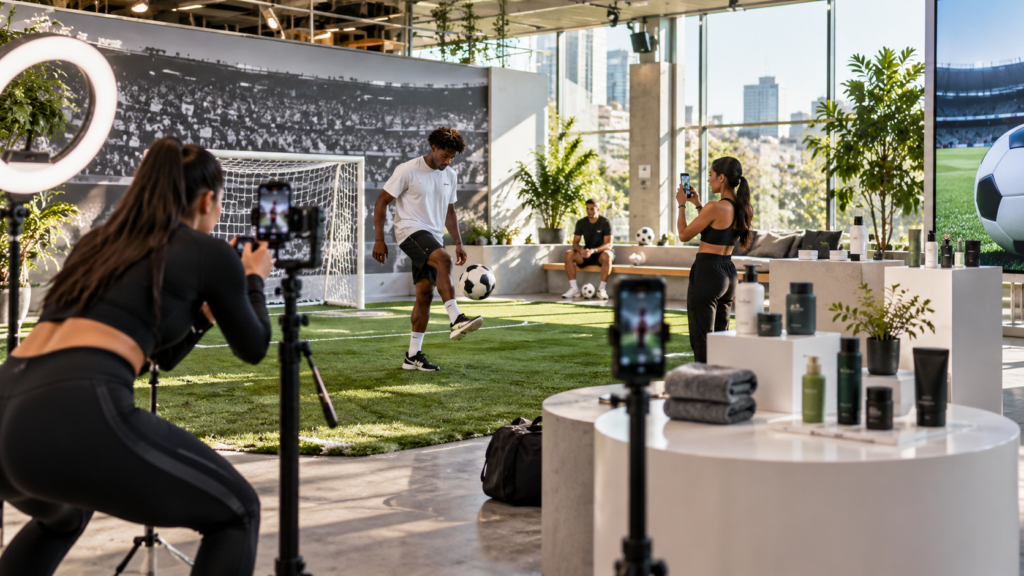
House of Fresh. House of Fresh is a creator-first experiential hub operating in Mexico City, New York and Miami, purpose built for social media feeds and social selling. These weren’t event spaces with Unilever logos on the walls. They were content creation infrastructure — branded and designed specifically for the kind of social-feed-ready content that drives organic reach on TikTok and YouTube. Unilever
The space rotated to feature a specific hero brand and activity, with Rexona offering competitive interactive games and Dove Men+Care hosting a talk with retired American football player and actor Marshawn Lynch and NWSL soccer star Trinity Rodman. The physical environment was engineered around the social output it needed to produce. Custom jersey stations, LED pitches, product walls, recording capabilities — every element was designed to make creators want to document it. Campaign Live
At peak, 200-250 creators cycled through the New York space daily. Dove events alone generated 2,000+ pieces of content and 120 million reach. The physical space was a content factory, and it ran at industrial scale.
The Locker Room. The Locker Room is a 24/7 social media hub delivering real-time, culturally responsive content across platforms including TikTok and YouTube. Where House of Fresh generated planned content, The Locker Room generated reactive content — turning unpredictable tournament moments into brand-relevant posts in real time, at the speed of culture. Unilever
Unilever World Cup campaign is employing an always-on marketing team working 24/7 from the conglomerate’s content hubs, each internally called The Locker Room. They are staffed by creator and community experts at Unilever and soccer strategists to quickly turn key tournament moments into viral social media content. Glossy
This is the operational capability that most brands don’t have and can’t quickly build. When something unexpected happens during a match — a controversial VAR decision, an extraordinary goal, a player moment that captures global attention — the brands that can respond within minutes own the conversation. The brands that go through a traditional approval process respond 48 hours later, when the moment has passed.
The Locker Room was Unilever’s answer to that problem. Built before the tournament, staffed around the clock, designed to move at the speed of culture.
The 50,000 Creators: Distribution, Not Decoration
The number most people focus on is 50,000. It sounds like a stunt — the kind of statistic designed to generate press coverage rather than commercial results.
The reality is more sophisticated. Unilever World Cup campaign has launched its largest-ever creator-led marketing campaign for the FIFA World Cup 2026, involving a whopping 50,000 influencers from 120 markets. The global initiative has the creators generating cross-market, cross-channel content to promote Unilever brands including Rexona (known as Degree in the US), Dove, Dove Men+Care and Axe. B&T
120 markets. That’s the key detail. The creator network wasn’t 50,000 large accounts concentrated in English-speaking markets. It was a genuinely global network — creators in Brazil who spoke to Brazilian football fans in Portuguese, creators in Mexico who reached Mexican audiences on their own platforms, creators across Asia, Africa, and Europe who brought the campaign into cultural contexts that no centrally produced content could reach authentically.
Unilever treats creators as a distribution channel rather than a single tactic, combining mega-creators for reach with nano-creators for credibility — a model designed to generate high volumes of shareable, trusted content more efficiently than traditional TV or static sponsorship.
The distinction between reach and credibility is crucial. Mega-creators generate awareness. Nano-creators generate trust. Unilever needed both — awareness at the scale of a global tournament, and credibility at the intimacy of a local community. 50,000 creators across 120 markets delivered both simultaneously.
The Brand Strategy: One Platform, Four Distinct Territorie
Here’s where the Unilever World Cup campaign gets genuinely sophisticated. The global campaign, led by Unilever Personal Care, will see over 35 brands activate, such as Dove, Dove Men+Care, Rexona/Degree and Axe/Lynx, ensuring players, spectators and fans are ‘fresh for every stage’. Unilever
Running 35 brands through a single World Cup sponsorship activation is an enormous operational challenge. The risk is fragmentation — each brand pulling in a different direction, diluting the overall impact. Unilever avoided that by giving each brand a distinct emotional territory within a single platform theme.
Dove: disrupting the tournament with girls’ joy.
Dove’s “The Game Is Ours” film used the real sounds of girls playing — breath, footsteps, ball impact — drowning out body criticism with pure athletic expression. A follow-up spot arrived in May, championing body confidence among girls in sports. Dove used its Palo Santo & Sage body-care range to drive QR-code ticket entries and donations supporting girls in sport.
This is Dove doing exactly what Dove does — using a cultural moment dominated by men’s football to advocate for girls’ participation in sport. It would have been easy for Dove to produce a generic football campaign. Instead they found the angle that was true to the brand’s identity and counterintuitive enough to stand out in the noise of the tournament.
Rexona: confidence under pressure, exactly where it matters.
For Rexona, confidence under pressure showed up on the touchline, quite literally under the arm. Logo placements for Rexona and Degree were strategically placed in the armpit areas on the shirts of the officiants holding up substitution boards for visibility during broadcasts. “It’s a soccer-world first to have the branding on the armpits of the officials, and you know it’s consciously done.” The DrumCampaign Live
This is one of the most precise brand placement decisions in World Cup marketing history. A deodorant brand placing its logo under the armpit of the official who raises the substitution board at the highest-stakes moments of the match. The product category is literally the body location. The placement is literally the category. It generated more than 1 billion in reach, while content from Roberto Carlos, Kerolin, Daniel Sturridge and Ben Foster added over 36 million. During the first six weeks, Rexona ranked fourth for social share of voice among all global sponsors.
Axe: the wilder side of football fandom.
AXE leaned into the wilder side of football fandom, including costumes, crazy hats and full-body paint, encouraging fans to “smell your best when you look your worst.” Where Dove went uplifting and Rexona went precise, Axe went irreverent — leaning into the Gen Z habit of switching scents to suit the moment with three limited-edition Fine Fragrance launches. The Drum
Dove Men+Care: the match-day skin reality.
Dove Men+Care built its tournament activity around the physical reality of fandom: painted faces, long hours in the sun, sweat and celebration. ‘Care for Your Skin Like You Care for the Game’ gave the brand a natural place in match-day rituals. The Drum
Four brands. Four territories. Zero fragmentation. Each one was true to its core identity while living authentically within football culture. That’s the creative discipline that prevented 35 brands from becoming a cacophony.
The Retail Layer: Where Culture Became Commerce
Cultural relevance without conversion is incomplete. Unilever understood this — and built the retail layer as deliberately as they built the creator layer.
Across the portfolio, more than 180 limited-edition products reached millions of stores. Rexona featured its football ambassadors on collectible cans. AXE tapped into the Gen Z habit of switching scents to suit the moment with three limited-edition Fine Fragrance launches. Dove used its Palo Santo & Sage body-care range to drive QR-code ticket entries and donations supporting girls in sport. Together, those products turned attention into something tangible. The Drum
The shelf became an extension of the experience, not an afterthought. Limited-edition products carried QR codes for World Cup ticket entries and triggered micro-donations to youth sports organizations. The purchase wasn’t just a transaction — it was participation in the campaign itself.
Fans visiting the Degree-branded “Club Fresh” could pick up travel-sized deodorants and soaps, capture photo moments and get a personalized “player card” by brand partner Panini. Campaign Live
The Panini integration is particularly smart. Panini sticker collections are a ritual of World Cup fandom — collecting, trading, completing albums. By connecting their retail activation to Panini’s collectible mechanic, Unilever tapped into a participation behavior that fans were already engaged in. Every product purchase became a fan moment, not just a commodity transaction.
180 limited-edition products across millions of stores globally. The creator content drove awareness. The retail activation converted that awareness into purchase. The loop was closed.
The Commercial Results
The business case for Unilever World Cup campaign investment is documented in hard commercial data.
Personal Care volume growth hit 6.8% in Q2. Unilever regained US deodorant market leadership. Key football markets like Brazil saw double-digit growth. The campaign drove 5.9% sales growth in a single quarter. Rexona generated over 1 billion in reach during the first six weeks alone. Axe Mexico clocked 241 million YouTube views. By the tournament’s opening day, Unilever brand videos accounted for 7.5% of 58 billion-plus World Cup YouTube views.
These numbers represent a complete commercial outcome — from top-of-funnel awareness through mid-funnel engagement to bottom-of-funnel purchase. The creator network generated the awareness. The House of Fresh activations deepened the engagement. The 180 limited editions converted the engagement into sales. The Locker Room sustained the momentum across 104 match days.
Most sponsorship campaigns optimize for one of these stages. Unilever optimized for all three simultaneously — and the results across all three reflect that.
What Made This Operationally Possible
The Unilever World Cup campaign looks like a creative achievement. It’s actually an operational one.
The Locker Room is a 24/7 social media hub where creators, community experts and football strategists can deliver reactive content across platforms like TikTok and YouTube in real time, at the speed of culture. B&T
Running a 24/7 content operation across multiple time zones, for 104 match days, with 50,000 creators across 120 markets, while simultaneously managing physical activations in three cities and retail programs across millions of stores — that’s not a campaign. That’s a logistics achievement.
The operational readiness was built before the tournament began. House of Fresh spaces were engineered for social-feed readiness before the first creator walked through the door. The Locker Room was staffed and operational before the opening match. The 180 limited editions were in stores before the first ball was kicked. The creator network was briefed and activated before the tournament created the moments they’d need to respond to.
This is the lesson that most brands miss when they try to replicate what Unilever did: the output was social content, but the input was operational infrastructure. You cannot improvise a 50,000-creator network into existence during a tournament. You build it before the tournament, then deploy it when the moment arrives.
The Five-Year Platform: A Capability Build, Not a Campaign
Perhaps the most important thing about Unilever’s World Cup activation is what it’s designed to become.
This wasn’t a two-month campaign. It was a capability build for a social-first model that extends to the 2027 Women’s World Cup and beyond. Unilever’s five-year FIFA partnership means the infrastructure they built for 2026 — the creator network, the House of Fresh model, The Locker Room operation — will be deployed again in Brazil in 2027, and refined with each tournament.
Every piece of the 2026 campaign generates learning. Which creator formats drove the most engagement? Which product categories saw the strongest retail lift? Which market-specific activations outperformed the global template? Which moments from The Locker Room generated the most organic reach?
That learning compounds. By the 2027 Women’s World Cup, Unilever will have two years of additional data, a more developed creator network, and a more refined operational model. By 2030, when the Men’s World Cup returns, they’ll have five years of iteration.
The brands that will win the next decade of cultural marketing aren’t the ones with the biggest budgets for a single campaign. They’re the ones building the infrastructure to compound their learning across campaigns. Unilever is building that infrastructure now.
Competitive Analysis: What Other Brands Can’t Replicate Immediately
The Unilever World Cup campaign is genuinely difficult to replicate — not because of budget, but because of organizational commitment.
The 50,000-creator network across 120 markets took years to develop. The relationships, the contracts, the briefing systems, the content standards — none of that can be assembled in the weeks before a major tournament. It requires the kind of long-term investment in creator relationships that most organizations don’t make because the returns aren’t visible until the moment arrives.
The Locker Room required organizational restructuring. Running a 24/7 content operation staffed by creator experts, community managers, and football strategists isn’t something you outsource to an agency two weeks before the tournament. It requires internal capability — people who understand both Unilever’s brand standards and the real-time dynamics of social platforms.
The five-year FIFA partnership provided the anchor for all of it. With a five-year commitment, Unilever could invest in infrastructure with confidence that they’d have the opportunity to learn from it and apply those learnings. A one-year sponsorship deal doesn’t justify the organizational investment that makes the House of Fresh and Locker Room possible.
Industry Implications: What This Changes for Brand Marketing
Creators are infrastructure, not media. The old model treats creator partnerships as a media buy — pay for placements, measure reach, repeat. Unilever World Cup campaign model treats creators as a distribution layer — build the network, create the experiences, let the content flow. The difference in scale and authenticity is enormous.
Physical spaces generate digital content. House of Fresh is a physical investment that produces digital returns. Every creator who walked through those doors in Mexico City, New York, and Miami left with content. That content traveled to audiences Unilever’s paid media never would have reached. Physical activations are undervalued as earned media generators — especially when they’re designed for social-feed readiness from the ground up.
Brand portfolios need coordinated territory mapping. Running 35 brands through a single sponsorship platform without fragmentation requires the kind of creative discipline Unilever demonstrated — one platform, distinct emotional territories for each brand, zero overlap. Most multi-brand sponsors produce noise. Unilever produced a coherent narrative with multiple voices.
The shelf is part of the campaign. 180 limited-edition products across millions of stores globally turned cultural engagement into purchase behavior. The retail layer isn’t separate from the cultural campaign — it’s the conversion mechanism that makes the cultural investment commercially defensible.
Lessons for Leaders
Build the infrastructure before you need it. The Locker Room, the creator network, and the House of Fresh model were operational before the tournament began. Leaders who try to build these capabilities in real time will always be too late. The investment in infrastructure has to precede the moment that makes it valuable.
Make long-term commitments to cultural platforms. Unilever’s five-year FIFA deal isn’t just a sponsorship commitment. It’s a learning commitment — a decision to compound organizational capability across multiple tournaments rather than treating each one as a standalone activation. Leaders who think in multi-year platforms build compounding advantages.
Treat the portfolio as a system, not a collection. Each Unilever brand found its own emotional territory within a single platform. That requires leadership that can hold the tension between brand differentiation and platform coherence — saying yes to distinct brand identities while saying no to fragmentation.
Lessons for Marketers
Give creators experiences, not scripts. The single most important creative decision Unilever made was to build spaces and moments worth documenting rather than messaging worth distributing. Scripts generate compliance. Experiences generate authenticity. And authenticity travels farther than any paid placement.
Real-time response is a creative capability. The Locker Room’s ability to turn tournament moments into brand content within minutes is a creative output — but it requires operational infrastructure. Marketers who want real-time cultural relevance need to invest in the organizational capability that makes it possible, not just the creative aspiration.
Connect culture to commerce explicitly. The QR codes on Dove products, the Panini cards at Club Fresh, the collectible Rexona cans — every element of the retail layer gave fans a specific action to take that connected their cultural engagement to a purchase behavior. Cultural relevance without a conversion pathway is brand building without a business model.
Lessons for Operators
Engineer environments for content output. House of Fresh didn’t happen by accident. Every element — the custom jersey stations, the LED pitches, the recording capabilities — was designed with the social output in mind. Operators building physical activations should work backward from the content they want creators to produce, then design the environment that makes that content inevitable.
Staff for real-time response. The Locker Room required people with specific skills — creator expertise, social platform knowledge, football cultural fluency, brand standards familiarity — operating around the clock. That staffing model is an operational investment. Build the team before the tournament, not during it.
Measure the retail lift, not just the reach. 6.8% volume growth and US deodorant market leadership recapture are the metrics that validate the Unilever investment. Operators should define the commercial KPIs of cultural campaigns upfront and build the retail activation that connects cultural energy to purchase behavior before the campaign launches.
The How-To Framework: Building a Creator-First Campaign Operating System
You don’t have 50,000 creators or three physical hubs. But the architecture is scalable.
Step 1 — Build the network before you need it. Creator relationships take time to develop. Start building the network — at whatever scale your resources allow — before the cultural moment you’re planning to activate around. The brands that win cultural moments are the ones that had their creator relationships in place when the moment arrived.
Step 2 — Design for experience, brief for content. Don’t hand creators scripts. Hand them environments, access, and moments worth documenting. Brief them on the emotional territory you want them to occupy, not the messaging you want them to deliver. The content will be more authentic and more shareable.
Step 3 — Build reactive capability. What’s your version of The Locker Room? Even a small team with clear authority to respond to cultural moments in real time is more valuable than a large team that requires multi-day approval cycles. Define who can respond, what they can say, and how fast they can move — before the moment arrives.
Step 4 — Map distinct territories for each brand or product. If you’re activating multiple products or services through a single campaign platform, give each one a distinct emotional territory that’s true to its core identity. Coherent differentiation beats fragmented individuality every time.
Step 5 — Close the loop at retail. Build the conversion mechanism before the campaign launches. What physical product, limited edition, promotional mechanic, or retail experience will convert cultural engagement into purchase? The campaign isn’t complete until the shelf is part of it.
Step 6 — Design for five years, not five weeks. The learning from a creator-first campaign compounds across activations. Document what worked, what didn’t, which creator formats drove the most conversion, which market activations outperformed the global template. Apply that learning to the next campaign. Build the capability, not just the activation.
Future Implications
Unilever’s 2026 World Cup activation will be studied as the moment when creator-first marketing moved from a tactical option to a strategic imperative for large consumer goods companies.
The brands that resist this shift — that continue to treat creators as a supplementary media channel rather than a primary distribution layer — will find themselves increasingly outpaced by brands that have built the infrastructure to move at the speed of culture.
The Women’s World Cup 2027 in Brazil will be the next proof point. Unilever arrives at that tournament with a more developed creator network, a refined operational model, and two years of learning from 2026. The brands they compete against will be starting where Unilever started in 2024 — building from scratch.
Authenticity over interruption. Context over coverage. Creators over scripts.
That’s not a trend. That’s the new operating model for cultural marketing at scale. Unilever built it. Everyone else is catching up.
FAQ
What was Unilever’s World Cup 2026 campaign?
The global campaign, led by Unilever Personal Care, saw over 35 brands activate, such as Dove, Dove Men+Care, Rexona/Degree and Axe/Lynx, ensuring players, spectators and fans are ‘fresh for every stage’. With creators at the heart of the activation, Unilever’s brands collaborated with a diverse network of influencers and content creators across its largest markets. Unilever
How many creators did Unilever use?
Unilever launched its largest-ever creator-led marketing campaign for the FIFA World Cup 2026, involving 50,000 influencers from 120 markets. B&T
What is House of Fresh?
House of Fresh is a creator-first experiential hub operating in Mexico City, New York and Miami, purpose built for social media feeds and social selling. Unilever
What is The Locker Room?
The Locker Room is a 24/7 social media hub delivering real-time, culturally responsive content across platforms including TikTok and YouTube. Unilever
What were the results of Unilever’s World Cup campaign?
Personal Care volume growth hit 6.8% in Q2, Unilever regained US deodorant market leadership, Brazil posted double-digit growth, and by the tournament’s opening day brand videos accounted for 7.5% of 58 billion-plus World Cup YouTube views.
What was the Rexona armpit placement?
Logo placements for Rexona and Degree were strategically placed in the armpit areas on the shirts of the officiants holding up substitution boards for visibility during broadcasts. “It’s a soccer-world first to have the branding on the armpits of the officials, and you know it’s consciously done.” Campaign Live
What was Dove’s World Cup campaign?
Dove’s “The Game Is Ours” film used the real sounds of girls playing to champion body confidence in sport, while its Palo Santo & Sage range carried QR codes for World Cup ticket entries and micro-donations to youth sports organizations.
What was Axe’s World Cup campaign?
AXE leaned into the wilder side of football fandom, including costumes, crazy hats and full-body paint, encouraging fans to “smell your best when you look your worst.” The Drum
How long is Unilever’s FIFA partnership?
Unilever signed a five-year partnership with FIFA in 2023, covering men’s, women’s and esports competitions, including the FIFA Women’s World Cup 2027 in Brazil.
Why did Unilever use creators instead of traditional advertising?
Unilever treats creators as a distribution channel rather than a single tactic — combining mega-creators for reach with nano-creators for credibility to generate authentic, trusted content more efficiently than traditional sponsorship.
What were the limited-edition products?
Across the portfolio, more than 180 limited-edition products reached millions of stores. Rexona featured its football ambassadors on collectible cans. AXE tapped into the Gen Z habit of switching scents to suit the moment with three limited-edition Fine Fragrance launches.