
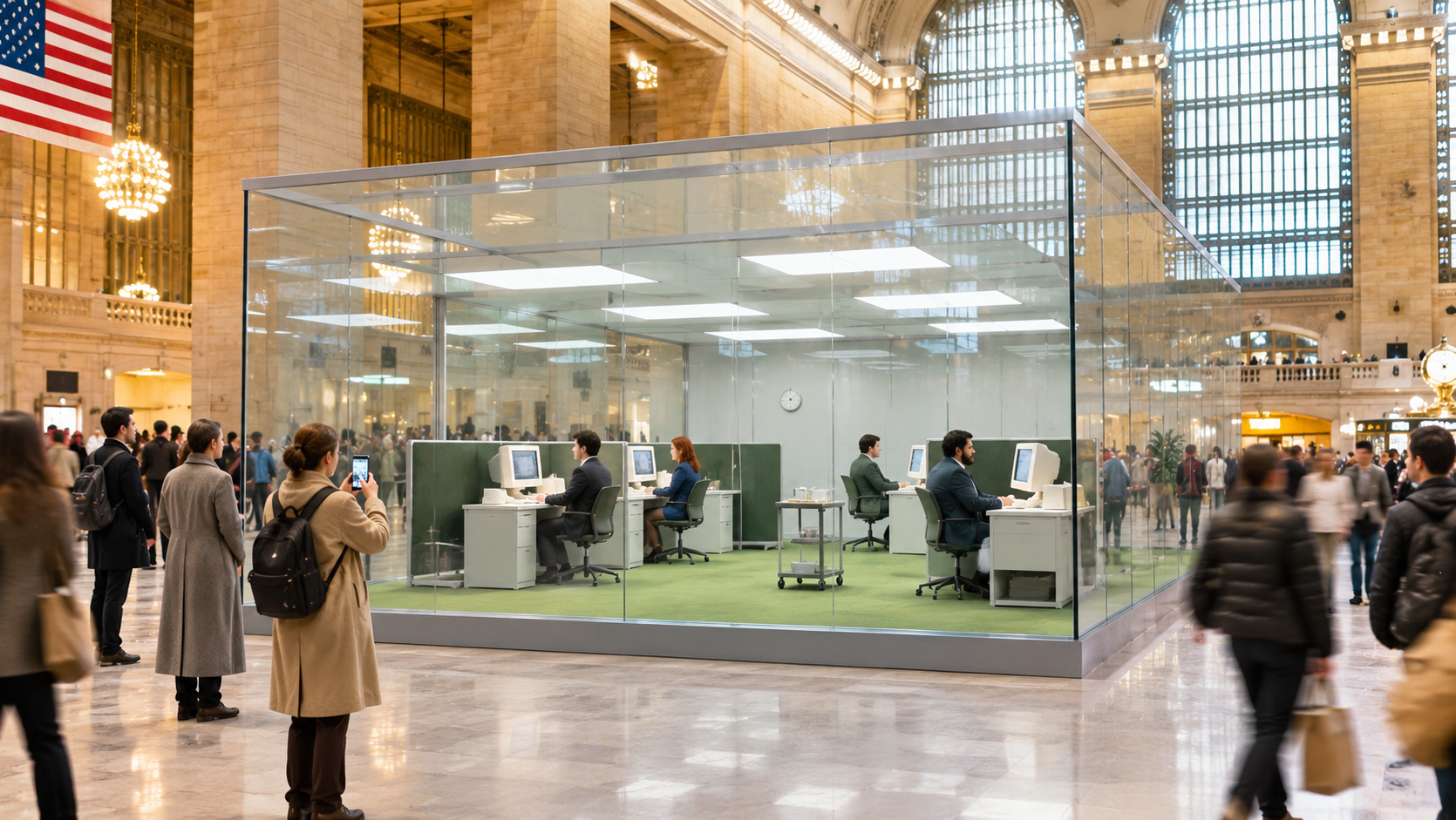
On January 14, 2025, Apple TV+ dropped a glass cube into Grand Central Terminal’s Vanderbilt Hall. Inside was a replica of the office set from Severance, staffed by cast members in character. Documented results from an industry case study include 53,000 direct commuter engagements, 500,000 visitors, more than 80,000 social mentions, and 3.5 million total social engagements. The Severance pop-up works as a case study because the idea explained itself. A show about work-life separation put its premise in front of people mid-commute. This article covers what Apple built, why it worked, which popular numbers don’t hold up under scrutiny, and how any brand can apply the playbook at its own scale.
The Cube That Stopped Rush Hour
Picture Grand Central at rush hour. Thousands of people move through the terminal, heads down, headed to work.
Then they hit a glass box.
On January 14, 2025, the cast of Severance appeared in character inside a pop-up glass office at Grand Central. Adam Scott, Britt Lower, and Zach Cherry worked in a replica of their office set. The cube was big enough for four cubicles and room to walk around the edges.
The glass was soundproof, so onlookers could only watch. Adam Scott said he stayed in the cube for three hours while people gathered around and watched the cast do boring, monotonous office work.
Commuters didn’t need a billboard to understand it. The show is about workers whose office selves and home selves can’t remember each other. Here was a version of that office, in a fishbowl, in the middle of a place built for commuting to work.
What Apple Actually Built
The Severance pop-up looked simple. The details are what made it work.
The set was obsessive. The pop-up included props that satisfy fans of the show, like the speaker Lumon’s bosses use to talk to staff. Fans also spotted the caricature portraits Lumon employees get for completing files and the red ball from an icebreaker scene in season one. Actors carried items like Lumon’s Compliance Handbook.
The cast showed up. Adam Scott, Britt Lower, Zach Cherry, and John Turturro worked in the cubicles, while Patricia Arquette and Tramell Tillman, who play their bosses, supervised. Director Ben Stiller made his way to Grand Central to see the stunt in person.
The performance stayed in character. One X user reported being told by a security guard that Lumon doesn’t employ actors. That’s the show’s tone, delivered in real life.
It ran for two days. A banner in the terminal said the exhibit would be active Tuesday and Wednesday. On day two, Time Out reported, more generic performers were inside while the cube stayed open until 8 p.m.
The result was a piece of the show’s world placed in the real one. The effect on fans, and on people who’d never seen an episode, was the same: stop and look.
The Idea That Explained Itself
The central strength of the Severance pop-up is that the concept needed almost no translation.
Severance is about work-life boundaries, corporate control, and surveillance. Apple didn’t run ads explaining that premise. It put the premise in a glass box and let New Yorkers confront it during their commute.
The stunt mirrored the show’s core tension. People were observed, performing repetitive tasks, while a crowd watched. The commuters watching were mostly on their way to their own offices.
That’s why it traveled. The cube was cinematic from every angle, and every phone in the crowd became a camera. A visual that works in a photo or a 10-second clip doesn’t need a caption.
A small caveat on “zero branding”: the cube itself carried the fiction, but the terminal also displayed a banner promoting the show. The concept needed little explanation. It wasn’t completely unlabeled.
The Numbers: What’s Documented and What Isn’t
This is where precision matters, because the most widely repeated figures aren’t all backed up.
What’s documented. An Out of Home Advertising Association case study on the campaign reports that the Grand Central cube drew 53,000 direct commuter engagements, 500,000 visitors, and more than 80,000 social mentions, contributing to 3.5 million total social engagements. Separately, the campaign’s out-of-home takeover generated 59.5 million impressions, not counting the cube.
What’s context, not proof of cause. Deadline reported a 126% increase in new Apple TV+ subscribers between January 1 and 19, 2025, compared with December 1 to 19, 2024. The activation happened during that window, but so did the season two premiere on January 17 and the rest of the marketing push. It’s a useful backdrop, not a measurement of the cube alone.
What I couldn’t verify.
- “1.1 billion social impressions.” I couldn’t find this in public sources. A Grand Central advertising listing says the activation produced hundreds of millions of impressions, but that’s from a company selling ad space at the terminal.
- “$0 on influencers” or zero spend. Apple hasn’t published a budget. The cube required a built set, actors, security, and production, and the campaign also included a paid out-of-home takeover. Public reporting doesn’t show a paid-creator push, but “zero spend” isn’t supported.
- “750,000 commuters over two days.” That figure is Grand Central’s average daily visitor count, not the number who walked past the cube. The case study cites 500,000 visitors.
None of this weakens the lesson. It makes the lesson more credible. The activation worked on documented numbers, without needing the inflated ones.
Why Experiential Marketing Works When the Idea Is This Tight
Most experiential campaigns fail because the activation is separate from the product. A branded booth, a free sample, a photo wall. The experience is a delivery mechanism for a message.
The Severance pop-up reversed that. The experience was the message.
It gave people a story. Everyone who saw the cube had something specific to tell someone: “Adam Scott was sitting in a glass box in Grand Central doing fake office work.” That’s more shareable than any slogan.
It rewarded fans without excluding everyone else. Superfans got the accurate props and in-character details. Passersby who had never watched the show got a strange, visual hook.
It chose its location for meaning. Grand Central is a place defined by commuting to work. The setting made the show’s theme land without a word.
It made the audience part of the scene. People watching the cube were the crowd in the story. Time noted the stunt went viral with largely favorable responses, while cautioning that its effect on Apple’s streaming numbers remained to be seen.
The Contrast With Standard Streaming Marketing
Typical streaming promotion relies on a familiar toolkit: trailers on YouTube, display ads, influencer partnerships, email blasts. Each of those competes for attention in a feed.
The Severance pop-up didn’t compete in a feed. It created something people chose to stop and look at, then put it into feeds themselves.
That’s the difference between interrupting a day and becoming part of it. A trailer asks for attention. A glass cube in the middle of your commute earns it.
It also worked because it wasn’t the only layer. The cube sat alongside a broad out-of-home campaign, which means the stunt amplified a campaign already building awareness. Experiential works best as the peak of a campaign, not a replacement for one.
Industry Implications
Concept strength matters more than budget. A small, well-chosen idea in a high-traffic setting can do more than a large generic one. The test is whether the idea explains itself.
Locations are media. Grand Central’s setting reinforced the show’s theme. Choose venues that add meaning, not just foot traffic.
Social is built into the design. The cube was designed to be photographed from every angle. Plan for the phones in the crowd.
Stunts amplify, they don’t replace. Pair them with sustained media so the moment has something to build on.
Claims need receipts. The most-shared numbers about this campaign were inflated. Brands and agencies reporting on activations should use sourced, defensible figures.
Lessons for Leaders
Fund the idea, not just the execution. The most important decision was the concept: the show’s premise, in a box.
Insist on defensible numbers. A case study you can source is worth more than a bigger number you can’t.
Use stunts to start conversations, not end them. The cube generated attention that other marketing channels could carry forward.
Lessons for Marketers
Find where your concept collides with reality. The best activations live at the point where the brand’s idea meets people’s actual day.
Design for the photo. Build the activation so a single image or short clip tells the story.
Reward your core audience without excluding newcomers. Accurate details for fans, a strong visual hook for everyone else.
Lessons for Operators
Plan the on-site details. Props, performers, security, and sightlines all shape whether the moment lands.
Prepare for the crowd. A successful activation draws people. Think through flow, safety, and permits.
Capture your own data. Track engagements, visitors, and mentions in a way you can defend later.
The How-To Framework: Finding Your “Cube Moment”
You don’t need Apple’s resources or Grand Central. You need a concept tight enough to explain itself.
Step 1: Name the core tension. What’s the single idea your brand or product is really about? Write it in one sentence.
Step 2: Find where it collides with real life. Where do your customers physically encounter that tension? A commute, a checkout line, a waiting room, a campus.
Step 3: Make it visible. Turn the idea into something people can see from a distance, with no explanation needed.
Step 4: Add detail for your core audience. Accurate props, in-jokes, or small touches that reward people who know you best.
Step 5: Design for the phone. Make sure the activation photographs well from several angles and works in a short clip.
Step 6: Pair it with sustained media. Don’t rely on one moment. Support it with channels that extend its reach.
Step 7: Measure what you can defend. Track direct engagements, attendance, mentions, and social engagement. Report what you can source.
Future Implications
The Severance pop-up raised the bar for TV marketing. Studios and brands will keep reaching for immersive, location-based stunts, and many will copy the tactic without the idea behind it.
The brands that get it right will do what Apple did: start with a concept strong enough to be understood at a glance, then find the setting that gives it meaning.
The lesson isn’t “build a cube in Grand Central.” It’s this: find where your concept meets real life, then make that collision impossible to ignore.
Frequently Asked Questions (FAQs)
What was the Severance pop-up at Grand Central?
On January 14, 2025, Apple TV+ placed a glass cube containing a replica of the show’s office set in Grand Central Terminal’s Vanderbilt Hall, with cast members performing in character.
Who was in the cube?
Adam Scott, Britt Lower, and Zach Cherry worked in the cubicles, with other cast members including Patricia Arquette and Tramell Tillman appearing as characters.
How long did the Severance pop-up last?
It ran Tuesday and Wednesday, closing at 8 p.m. on the second day. The main cast performed on the first day, with Adam Scott reporting about three hours in the cube.
Could people hear the actors?
No. The glass was soundproof, so onlookers watched without hearing.
What results did the Severance pop-up produce?
An industry case study reports 53,000 direct commuter engagements, 500,000 visitors, more than 80,000 social mentions, and 3.5 million total social engagements.
Did the pop-up generate 1.1 billion impressions?
I couldn’t verify that figure in public sources. Documented reporting points to hundreds of millions of impressions across social and press, though the source for that is a company that sells ad space at the terminal.
Did Apple spend nothing on the campaign?
Apple hasn’t published a budget. The activation required a built set, performers, and production, and the campaign included a paid out-of-home takeover.
Did the pop-up drive subscriptions?
Deadline reported a 126% rise in new Apple TV+ subscribers from January 1 to 19, 2025, versus December 1 to 19, 2024. The activation fell within that window, along with the season two premiere on January 17, so the cube alone can’t be credited.
When did Severance season two premiere?
January 17, 2025, on Apple TV+.
What can small brands learn from the Severance pop-up?
Choose a concept that explains itself, place it where it connects to real life, design it to be photographed, and measure results you can source.
On January 14, 2025, Apple TV+ placed a glass cube containing a replica of the show’s office set in Grand Central Terminal’s Vanderbilt Hall, with cast members performing in character.
Adam Scott, Britt Lower, and Zach Cherry worked in the cubicles, with other cast members including Patricia Arquette and Tramell Tillman appearing as characters.
It ran Tuesday and Wednesday, closing at 8 p.m. on the second day. The main cast performed on the first day, with Adam Scott reporting about three hours in the cube.
No. The glass was soundproof, so onlookers watched without hearing.
An industry case study reports 53,000 direct commuter engagements, 500,000 visitors, more than 80,000 social mentions, and 3.5 million total social engagements.
I couldn’t verify that figure in public sources. Documented reporting points to hundreds of millions of impressions across social and press, though the source for that is a company that sells ad space at the terminal.
Apple hasn’t published a budget. The activation required a built set, performers, and production, and the campaign included a paid out-of-home takeover.
Deadline reported a 126% rise in new Apple TV+ subscribers from January 1 to 19, 2025, versus December 1 to 19, 2024. The activation fell within that window, along with the season two premiere on January 17, so the cube alone can’t be credited.
January 17, 2025, on Apple TV+.
Choose a concept that explains itself, place it where it connects to real life, design it to be photographed, and measure results you can source.