
Most beauty collabs are paint-by-numbers: beauty brand + beauty influencer + predictable launch calendar + perfectly safe content. Everyone looks good. Nobody remembers it a week later.
Then a canned water brand that markets to mosh pit enthusiasts teamed up with a mass‑market beauty darling and quietly rewrote the playbook.
This is the story of the Liquid Death x e.l.f. “Corpse Paint” collaboration — and what it should change about how agencies think about demand, partnerships, and brand positioning.
Most beauty collabs are paint-by-numbers: beauty brand + beauty influencer + predictable launch calendar + perfectly safe content. Everyone looks good. Nobody remembers it a week later.
Then a canned water brand that markets to mosh pit enthusiasts teamed up with a mass‑market beauty darling and quietly rewrote the playbook.
This is the story of the Liquid Death x e.l.f. “Corpse Paint” collaboration — and what it should change about how brands think about demand, partnerships, and positioning.
When a Canned Water Brand Out-Beautied the Beauty Industry
On paper, this collab had no business happening.
- Liquid Death sells mountain water in tallboy cans with metal‑band skulls and the tagline “Murder Your Thirst.” Their brand lives in mosh pits, skate parks, and unhinged humor.
- e.l.f. Cosmetics sells $8 lipstick that performs like $40 lipstick, wins on TikTok, and drives 18 million shop visits per quarter from people who want premium‑feeling products without prestige pricing.
Beauty brand + punk water brand is not the obvious pairing.
That’s exactly why it worked.
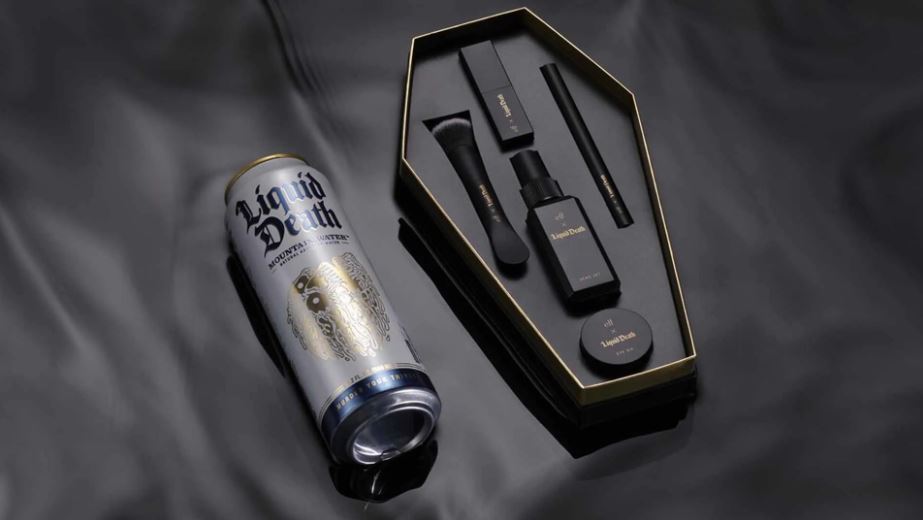
In March 2024, the two launched the “Corpse Paint” vault: a coffin‑shaped box filled with black metal‑themed makeup. Black lipstick called “Kiss of Death.” Setting spray named “Dead Set.” Themed to the kind of corpse paint you’d see on a Scandinavian black metal album cover.
It sold out in 45 minutes.
Within hours, kits were reselling for $125. Within two weeks, the campaign generated 12 billion impressions because nobody could decide if it was genius, insane, or both. That confusion became the fuel.
They didn’t stop there. In January 2026, they ran it back with “Lip Embalms”: lip balms shaped like mini Liquid Death cans, with flavors like “Severed Lime” and “Rest in Peach,” a death‑metal mascot named Glothar, and a metal jingle about dry lips leading to leprosy. There was even a Roblox integration to extend the weird into a virtual world.
This wasn’t a seasonal collab. It was a masterclass in what happens when brands stop respecting imaginary category walls.
The Power of the Strategic Mismatch
Most collaborations are built on tidy, logical overlap:
- Beauty brand + beauty influencer
- Skincare brand + dermatologist
- Fitness brand + fitness app
On a media plan, that makes perfect sense. To a human scrolling a feed, it’s invisible.
Liquid Death x e.l.f. did the opposite. They engineered a mismatch on purpose.
- Hardcore metal aesthetic + accessible, affordable beauty
- Death metal humor + cheerful, playful brand tone
- “Murder Your Thirst” + “eyes, lips, face”
There’s friction there. But instead of smoothing it out in the name of “brand alignment,” they leaned into it. The dissonance is the hook. It forces a double‑take:
“Wait, why is my favorite water brand selling corpse paint?”
“Why is this cute value beauty brand doing death metal makeup?”
In an environment where attention is the scarcest commodity, that moment of cognitive dissonance is gold. The mismatch makes the campaign worth talking about. And once people are talking, they’re doing your distribution for you.
For brands: If your collabs make too much sense, they’re probably not doing enough.
Your Customers Are Not One-Dimensional
Most bland collaborations come from a flawed assumption:
“Our customers are [category]. They care about [category stuff]. So we should partner with other [category] brands and people.”
But real humans don’t live in single‑category silos.
- The metalhead in a battle vest absolutely uses moisturizer.
- The beauty junkie in line for festival merch is also hydrating with canned water.
- The gamer also wears perfume.
- The DIY home renovator buys luxury skincare.
People contain contradictions. Winning brands reflect that back instead of ignoring it.
Liquid Death and e.l.f. didn’t invent a new audience. They surfaced a slice of reality the industry wasn’t paying attention to: the overlap between “people who love chaotic, irreverent humor” and “people who buy beauty products.”
The strategic question for your brand:
- What seemingly unrelated passions do your customers already have?
- Which of those passions are under‑served or under‑leveraged by your category?
- What would happen if you built a campaign at the intersection instead of staying politely in your lane?
The “wrong” partner is often a shortcut to the most right feeling: “Finally, a brand that gets me.”
Weaponizing Absurdity: Why the Campaign Hit So Hard
This collaboration didn’t just pair two brands. It built a mini‑universe around a single, absurd premise and committed to it fully.
Several strategic levers made it explode:
1. The Mismatch Was the Strategy
The campaign didn’t try to hide how weird the pairing was. It weaponized that weirdness.
- The coffin‑shaped “Corpse Paint” vault looked like a prop from a horror film.
- Product names like “Kiss of Death” and “Dead Set” didn’t wink at the theme — they went all in.
- Messaging embraced the “is this real?” confusion rather than over‑explaining the concept.
Every confused comment, every quote‑tweet, every “who asked for this?” post was free distribution. The internet loves to share things it doesn’t quite know how to categorize.
Too many campaigns die in committee because someone is afraid of confusion. This collab proves that controlled confusion is a growth channel.
2. Scarcity Turned Makeup into a Collectible
They didn’t just launch a product. They designed for scarcity and status.
- Limited quantity.
- Fast sellout.
- Immediate resale market with markups.
The second a product starts reselling for 3–5x retail, it stops being “makeup” and becomes a collectible, a flex, a token of membership in a culture.
Scarcity also resets what people consider “normal” behavior. It suddenly becomes reasonable to:
- Set alarms for a drop.
- Share reminders in group chats.
- Show off the haul in content.
Brands often think in terms of reach and reach and frequency. Scarcity forces you to think in terms of heat — intensity of interest — not just width of exposure.
3. Entertainment Came First, Product Second
Most marketing tries to convince people they need something:
- “This solves a problem.”
- “This is better than what you have.”
This campaign chose a different path: make people feel something first, and let purchase be the way they participate in the joke.
The Lip Embalms didn’t just launch with product shots and a list of ingredients. They arrived with:
- A death‑metal mascot (Glothar).
- A ridiculous song about dry lips causing leprosy.
- A world where lip balm was treated with the same over‑the‑top seriousness as a concept album.
You don’t watch that kind of content because you’re in-market for lip balm. You watch it because it’s entertaining. The purchase is the punchline.
Reminder for brands: If your campaign wouldn’t be worth watching with the sound off and the logo blurred out, you’re probably making an ad, not culture.
How Brands Can Apply This Playbook
You can’t copy‑paste corpse paint onto every client. But you can steal the structure.
Here’s how to turn this into a repeatable framework:
1. Start with Customer Contradictions
Run a session that explores:
- What’s something your customers love that has nothing to do with your category?
- What fandoms, subcultures, or hobbies keep showing up in your social listening data?
- What’s a part of their identity they don’t see reflected in your industry’s marketing?
Document those intersections. They’re your opportunity zones.
2. Map Out “Wrong but Right” Partners
For each contradiction, brainstorm:
- Which brands or cultural entities live in that other world?
- Which of them share your values (tone, stance, audience) even if they don’t share your product space?
- Who would make people say, “They did what together?” in a good way?
Your goal isn’t alignment on product. It’s alignment on attitude.
3. Design the Drop, Not Just the Ad
Think beyond “collab post and co‑branded packaging.”
Consider:
- A hero product or experience with built‑in scarcity.
- A visual or physical element that feels collectible.
- A narrative world that can be expressed in video, social, and IRL.
Ask: if this went away forever after two weeks, would people feel a little FOMO? If the answer is no, you haven’t made it special enough.
4. Build for Screenshots and Reactions
In a feed world, the unit of value isn’t impressions; it’s screenshots, stitches, and duets.
Design moments that prompt:
- “You have to see this” DMs.
- Reaction videos (“What did I just watch?”).
- Confused quote‑tweets and comments.
The Liquid Death x e.l.f. campaign wasn’t designed to be perfectly understood. It was designed to be perfectly reacted to.
5. Protect the Weird in Execution
This kind of work dies easily without commitment.
- Define “non‑negotiable weirdness” up front: elements that must survive revisions.
- Set guardrails based on true risk (legal, safety) vs. perceived risk (someone might be confused).
- Use prototypes and small tests to prove the concept before a full roll‑out.
Your value isn’t just in having the idea — it’s in seeing it through without losing the spark.
The Real Lesson: Your Category Isn’t the Center of Their Universe
The point of the Liquid Death x e.l.f. collaboration isn’t “go find a random brand and mash your logos together.”
The real lesson is much simpler and much harder:
Stop assuming your customers only care about your category.
They don’t wake up in the morning thinking “beauty” or “beverages” or “B2B SaaS.” They wake up as whole people with overlapping interests, contradictions, and weird little obsessions.
Brands that acknowledge that complexity — and have the courage to create at those intersections — will always out‑perform brands that stay neatly inside their category box.
Next time you’re planning a collab, ask yourself:
Does this reflect the full, messy reality of my customer?
Or does it just keep us safely inside our lane?
Let’s see what happens when you stop being boring — and start handing out coffin‑shaped vaults full of corpse paint instead.