Executive Synopsis
When Verity Marketing began working with this established Orange County design-build firm, the company had built a respected reputation for over three decades — generating $10 million in annual revenue through in-person seminars requiring direct mail, Pardon Our Dust direct mail, referrals, word-of-mouth, and the quality of its work. The brand had a good presence with even greater opportunity to succeed once we filled in the gaps in the customer journey and funnel opportunity.

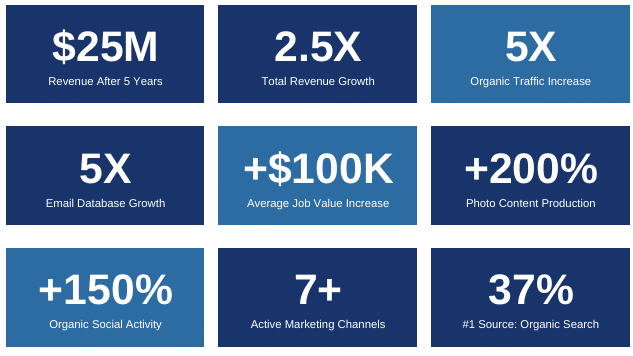
What followed was a five-year partnership that transformed how the firm attracted, nurtured, and converted clients. Organic traffic grew 10X — with organic search becoming the firm’s single largest traffic source at 37% of all visits. The email database expanded 5X. Average job value climbed by $100,000.
A structured repeat buyer program using personalized holiday outreach drove return business. Micro conversions tracking appointments booked versus ran exposed predictable funnel decay at every stage, producing a fully forecasted revenue model so accurate that actual results come in hairlines off the forecast year after year. And through a disciplined multi-channel strategy, the firm grew from $10 million to $25 million in annual revenue — a 2.5X revenue increase over five years, showcasing the effectiveness of strategic marketing efforts in driving significant growth and reaching a substantial milestone of 2.5X revenue.
This growth was not just about numbers; it was about understanding the factors that led to a 2.5X revenue increase, ensuring every aspect of the business aligned with strategic goals.
The Full Story
The Client: A Legacy Business Ready for Growth
Founded more than 30 years before engaging Verity, the firm had built its business the way most design-build companies do — through referrals, relationships, and the quality of its craft. Awards lined the walls. Clients returned. But the competitive landscape in Orange County was shifting. Homeowners were searching online, comparing firms on social media, and making decisions based on digital presence long before picking up the phone. The firm had the expertise. It needed the reach.
Year One: Listening Before Leading
Verity’s first year with the firm was intentionally measured. Rather than immediately deploying campaigns, the team focused on understanding the firm from the inside out — how leads came in, where they fell off, how the sales process worked, and what signals indicated a qualified buyer. That year revealed a critical insight: the firm was winning in spite of its systems, not because of them. There was no consistent source attribution, limited follow-up automation, and a customer journey that relied too heavily on individual effort. At the end of year one, the firm had seen enough to commit fully.
The Strategic Blueprint: Full-Funnel, Multi-Channel
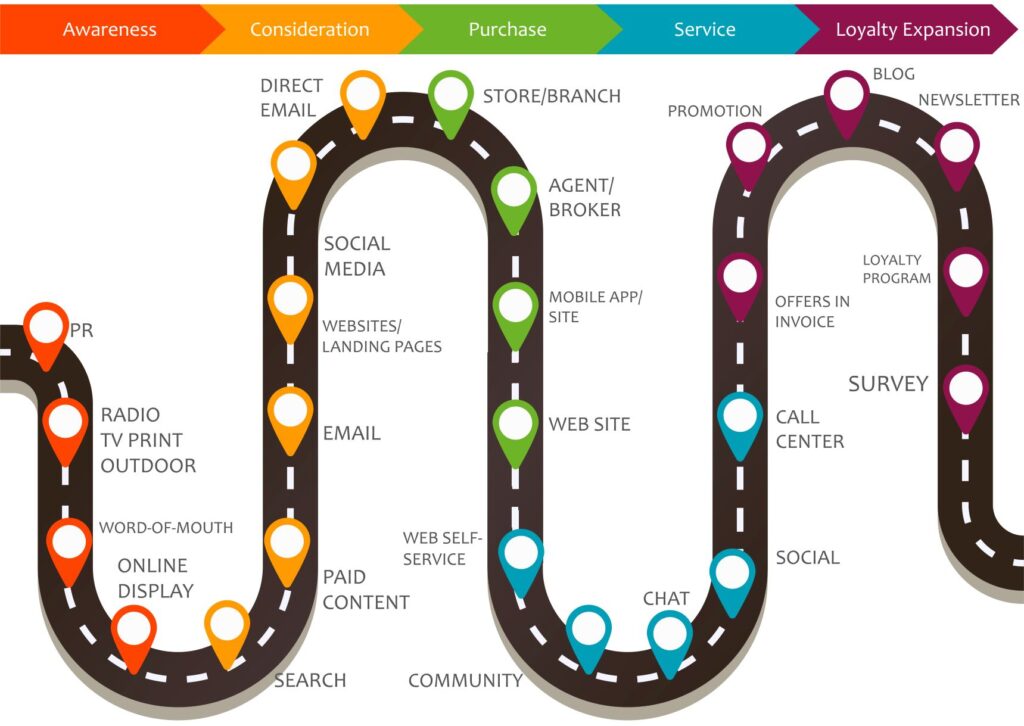
Once the decision was made to invest fully, Verity developed a comprehensive growth strategy across every stage of the funnel. Photography production increased by 200%, creating a deep content library that fueled every channel. Organic social activity increased by 150%, with consistent cadence and strategic storytelling designed to build familiarity over time. Paid media was layered in across Meta, programmatic placements, and Google Ads — each serving a distinct role in the funnel.
SEO, GEO, and AIO strategies were deployed to build long-term organic visibility. Within five years, organic traffic had grown 5X — and organic search became the firm’s single largest traffic source, accounting for 37% of all website visits. Email marketing rounded out the plan, keeping past clients and warm prospects engaged. The email database grew 5X over the course of the engagement, becoming one of the firm’s most valuable long-term assets.
Micro Conversions: A Forecasting Engine That Proves Itself Every Year
One of the most strategically significant — and operationally powerful — outcomes of the engagement was the development of a fully forecasted revenue model built on micro conversion tracking. The key insight came from a simple but revealing distinction: appointments booked versus appointments that ran. Tracking this gap exposed a predictable funnel decay at every stage — from raw lead to booked appointment to ran appointment — each with its own measurable conversion rate.
Once those decay rates were established, the model snapped into focus. Given a known number of leads entering the top of the funnel, the firm could predict with confidence how many appointments would be booked, how many would run, and how many would convert to signed contracts — all the way down to projected revenue. Conversion rates at each stage were layered in, creating a completely forecasted model that accounted for drop-off at every step rather than relying on a single close rate applied to raw lead volume.
The proof is in the results. Each year, the firm’s actual topline and bottom-line revenue come in hairlines off the forecast — consistently and repeatedly. That level of accuracy is not luck. It is the product of a model built on real funnel behavior, tracked over time, and refined with each cycle. For leadership, it transformed revenue planning from an educated guess into a reliable operating instrument — and gave them the confidence to make hiring, investment, and growth decisions backed by data they could trust.
Closing the Funnel Before Filling It
Before a single paid ad went live, Verity conducted a thorough funnel analysis and customer journey mapping exercise — finding every gap where a lead could fall through the cracks. CRM automations were deployed to eliminate manual follow-up gaps. Source attribution was built directly into the CRM so every lead and every dollar could be traced back to its origin. Structured communication sequences were added at each stage. Only once the funnel was sealed did Verity recommend opening the paid media investment.
Average Job Value: A Hidden Lever
One of the most impactful — and often overlooked — results of the engagement was the increase in average job value. Through more precise targeting, better-qualified leads entering the funnel, and a consultative sales process supported by rich visual content and strategic positioning, the average project value increased by $100,000. When compounded across dozens of projects per year, this single metric represented millions in additional annual revenue independent of any increase in lead volume.
Repeat Buyers: The Holiday Touch
A simple but highly effective addition to the strategy was a structured repeat buyer program anchored by personalized outreach. Valentine’s Day and Thanksgiving cards — sent to past clients — kept the firm top of mind during moments when homeowners are naturally reflecting on their spaces and their lives. The result was a measurable uptick in return business and referrals from clients who felt genuinely valued. In a relationship driven industry, this kind of human touchpoint at scale proved to be one of the highest-ROI elements of the entire program.
The firm’s vision for a sustained 2.5X revenue increase demonstrates the long-term potential of well-executed strategies.
Ultimately, achieving a 2.5X revenue increase showcases the collaborative effort towards a common goal in this competitive market.
As a result, they have not only reached but are on the path to further expanding their 2.5X revenue increase.
In conclusion, the firm’s dedication to achieving a 2.5X revenue increase highlights the importance of strategic marketing execution.
This concrete evidence of achieving a 2.5X revenue increase illustrates the power of effective marketing partnerships.
As they continue to refine their strategies, the firm is committed to sustaining their success and exploring further avenues for a 2.5X revenue increase.
The firm’s journey serves as a model for others seeking to achieve similar results, aspiring for their own 2.5X revenue increase.
Furthermore, continuous learning and adaptation have been keys to achieving the remarkable 2.5X revenue increase.
Ensuring that every team member understands the impact of their role on the overall goal of a 2.5X revenue increase has been pivotal.
The realization of a 2.5X revenue increase has encouraged the firm to further invest in innovative marketing practices.
By implementing these strategies, the firm not only achieved but sustained a 2.5X revenue increase, redefining its market presence.
This case study highlights the transformational impact of marketing strategies that achieve a 2.5X revenue increase through innovation and commitment.
With a focus on scalable strategies, the firm is now well-positioned for continued growth, aiming for a further 2.5X revenue milestone in the future.
Ultimately, this journey towards a 2.5X revenue increase has set a new standard for what is achievable in the industry.
This experience has underscored the importance of sustained effort in reaching the ambitious goal of a 2.5X revenue increase.
The firm’s success story is a testament to how insightful marketing can lead to a remarkable 2.5X revenue increase while preserving quality.
Every marketing initiative was meticulously crafted to align with the overarching strategy of achieving a 2.5X revenue target, showcasing the firm’s dedication to excellence.
The commitment to data-driven decisions facilitated the journey towards achieving the 2.5X revenue growth while maintaining the integrity of the brand.
Five Years Later: 2.5X Revenue and Climbing
Five years after committing fully to the partnership, the firm had grown from $10 million to $25 million — a 2.5X revenue increase achieved without sacrificing the quality or craft that had defined it for three decades. The team had grown thoughtfully, guided by KPI frameworks centered on revenue per employee and market size that ensured headcount decisions were always data-supported. The pipeline was full, measurable, and diversified across seven or more active channels. The marketing machine built with Verity continued to generate compounding returns.
Key Takeaway
This is not a story about a single campaign or a viral moment. It is a story about what happens when a firm with genuine expertise decides to match that expertise with a disciplined, full-funnel marketing strategy — and commits to the partner and the process long enough to let financial compounding work. The most important decision this firm made was not which channel to invest in. It was the decision to understand their funnel before filling it, and to trust the data every step of the way.
Get your complimentary consultation with Verity Marketing and let’s see what we can do for you.