


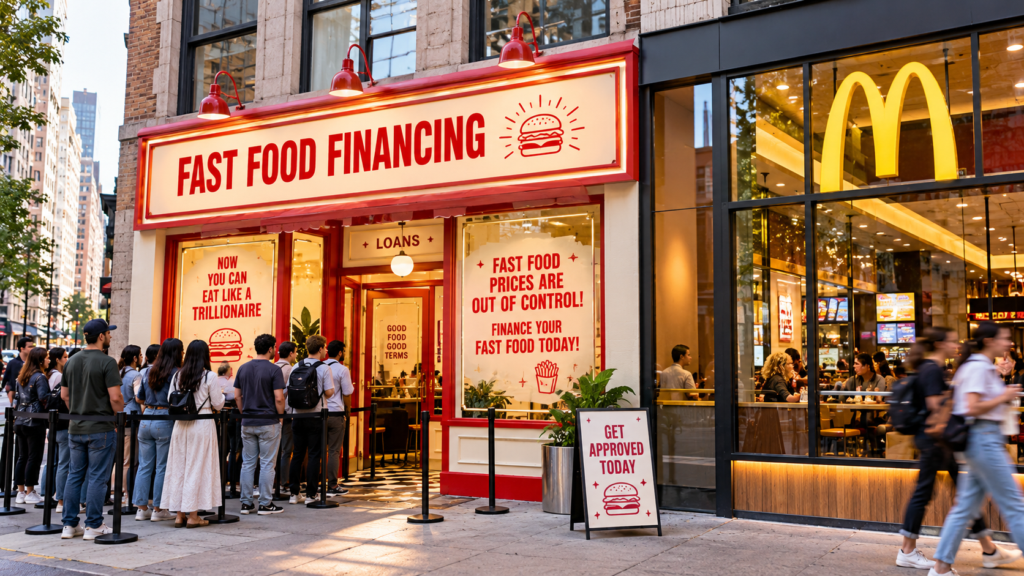
On April 16, 2025, Chili’s opened a fake payday loan office at 37 Union Square West in New York City — strategically placed next to a McDonald’s — and ran it for exactly two days. Visitors filled out absurd loan applications, got “approved” with a rubber stamp, received a $20 gift card, and walked through a hidden vault door into a speakeasy where they tried the new Big QP burger with bottomless chips and drinks. Lines wrapped the block. Social media exploded. But here’s what most coverage missed: the stunt wasn’t a stunt. It was the loudest expression of a three-year strategic repositioning that had already produced 31% same-store sales growth — what analysts called the best turnaround in restaurant industry history. This is the full story of how Chili’s got there, why the activation worked, and what every marketer and business leader can learn from a brand that committed to a position and found the moment to make it impossible to ignore.
The Moment That Made the Internet Stop
The garish exterior was plastered with signs blaring messages like “Now You Can Eat Like a Trillionaire” and “Fast Food Prices are Out of Control! Finance Your Fast Food Today!” contrasting with a sleek McDonald’s next door.
The visual contrast did more work than any advertising headline could. A garishly decorated payday loan storefront — complete with neon signage, absurd loan application forms, and a rubber stamp marked “APPROVED” — sitting directly beside the clean, confident golden arches of McDonald’s. The juxtaposition made the competitive statement without requiring a single word of explanation.
Guests would go through a mock loan-approval process, mimicking an actual financing office, before being “approved” to receive their gift card, and once cleared they’d be ushered into a Chili’s speakeasy for the full Big QP meal experience.
The speakeasy reveal — a hidden vault door opening into a full dining experience — turned a marketing activation into a story worth telling. Everyone who went through that door had a narrative to share: the absurd loan office, the approval stamp, the unexpected reveal, the burger that was genuinely better than what they’d been financing next door.
That’s not a stunt. That’s experiential storytelling designed to generate social currency. And it worked because everything behind it had been building for three years.
The Turnaround Nobody Was Watching
To understand why the Fast Food Financing pop-up landed the way it did, you have to understand what Chili’s had been building since 2022.
The performance put an exclamation point on a remarkable turnaround at Chili’s under Kevin Hochman, who took over as CEO of parent company Brinker International in 2022.
When Hochman arrived, Chili’s was a brand in quiet decline — not dramatically failing, but slowly losing relevance as fast food prices rose and casual dining struggled to define its value proposition. The turnaround plan wasn’t flashy. It was disciplined.
The second big-ticket item Chili’s focused on was labor — over $100 million has been invested in adding more hourly workers to ensure every restaurant is clean and providing excellent service with minimal wait times for guests. Chili’s has slowed down new builds to redeploy that capital into its existing restaurants, and has invested hundreds of millions of dollars incrementally to make sure their restaurants are in the best possible condition.
Better ingredients. Faster kitchens. Simplified menus. More staff. These aren’t marketing decisions — they’re operational ones. And they preceded the marketing that made the brand famous again.
The chain’s turnaround plan took seven quarters to turn traffic to positive, CEO Kevin Hochman said.
Seven quarters. That’s nearly two years of grinding operational improvement before the marketing could do its work. The Fast Food Financing pop-up looks spontaneous and bold. It was the culmination of seven quarters of infrastructure building.
The 3 For Me Weapon
At the center of everything Chili’s built is a single menu innovation: the 3 For Me meal deal.
“We believe Chili’s 3 For Me menu, starting at just $10.99, has been the best value in the industry since we introduced it in 2022, and we just made it even better with the new Big QP burger, featuring a fast food flavor profile our guests will recognize,” said George Felix, Chili’s chief marketing officer. tribune
$10.99 for a full casual dining meal — starter, entrée, drink — at a moment when McDonald’s value meals were creeping toward and past that price point. The pricing wasn’t accidental. It was a deliberate positioning stake: Chili’s planted its flag at the exact price point where the fast food value proposition was breaking down, and held it there.
Key drivers of Chili’s success include the Triple Dipper appetizer deal, which has doubled its share of total sales to 14%, and the 3 For Me meal deal, offering a three-course meal starting at $10.99.
The Triple Dipper — a shareable appetizer sampler that went viral on TikTok before Chili’s even fully understood what was happening — became the cultural proof point for the value proposition. When something goes viral because people are genuinely excited about it, it tells you the product is meeting a real need. Chili’s leaned into it.
In the second quarter of 2025, the brand’s same-store sales saw a tremendous increase of 31.4 percent over last year — a staggering number for a casual restaurant brand in today’s challenging macroeconomic environment. Traffic lifted 19.9 percent, and the Triple Dipper accounted for 14 percent of sales, which is twice as much as a year ago. fsrmagazine
The Big QP and the Competitive Escalation
The Fast Food Financing pop-up wasn’t Chili’s first attack on McDonald’s. It was the third act of a deliberate competitive escalation.
It continues Chili’s attack on fast-food prices, and particularly sector leader McDonald’s. Last year, Chili’s launched a Big Mac analog, the Big Smasher burger, and ran ads arguing that Chili’s 3 for Me meal offers a better value than fast food. restaurantbusinessonline
The pattern is clear in retrospect. The Big Smasher evoked the Big Mac. The Big QP evoked the Quarter Pounder. Each product launch was a direct comparison, positioned not as imitation but as superior value. And each one came with creative that amplified the comparison.
Chili’s version contains two slices of American cheese, mustard, ketchup, pickles, diced onions, and 85% more beef than McDonald’s quarter pounder. restaurantbusinessonline
The “85% more beef” claim is a masterpiece of competitive positioning. It’s specific enough to be credible, significant enough to be memorable, and framed as a direct product comparison rather than a vague superiority claim. Every element of the Big QP campaign forced the audience to make the same evaluation: why am I paying more for less?
The Fast Food Financing pop-up made that question into a physical experience.
The Five Decisions That Made It Work
Coverage of the Fast Food Financing activation focused on the creative execution. What made it work was a set of strategic decisions that most brands won’t make.
Decision One: Proximity beats traffic.
The location, strategically placed next to a McDonald’s, also features a speakeasy serving the Big QP.
They didn’t choose a high-traffic location and hope competitors were nearby. They chose the competitor’s location and built around it. The McDonald’s wasn’t the backdrop — it was the entire point. The visual contrast between garish payday loan office and polished golden arches did the competitive storytelling without a single line of copy.
Most brands optimize for footfall. Chili’s optimized for contrast. The result was an activation that generated its own visual headline wherever it appeared in photos and video.
Decision Two: Satire with utility.
The concept could have been mean-spirited — a cheap shot at McDonald’s prices that felt punching. Instead, Chili’s handed out $20 gift cards to offset the outrageous cost of fast food meals, and gave away free Big QP burgers complete with fries, bottomless chips and salsa, and an unlimited drink.
The satire was generous. People laughed with the brand while getting actual value. The joke had a punchline that tasted good. This is the distinction between a stunt that generates resentment and one that generates affection — when the brand takes the risk of being self-deprecating or satirical, they earn the laugh by also delivering the goods.
Decision Three: Product integration.
After approval, customers would then have access to a speakeasy to taste the new Big QP burger.
Every element of the activation drove trial of a specific product. The joke had a commercial purpose. The gift card converted to full meals. The speakeasy experience gave people a sensory memory of the Big QP — not an advertisement for it, an actual memory of eating it. Trial that happens inside an experience is worth far more than trial that happens from a coupon.
Decision Four: Cultural timing.
The Chili’s Fast Food Financing pop-up brings the pugnacious energy into the experiential realm. The garish exterior is plastered with signs blaring messages like “Now You Can Eat Like a Trillionaire” and “Fast Food Prices are Out of Control!”
Fast food prices had become a genuine national conversation by April 2025. Delivery apps were genuinely floating meal financing options. The “$20 Big Mac” had become a shorthand for consumer frustration with fast food inflation. Chili’s showed up with the perfect satirical mirror at exactly the moment the cultural conversation was primed for it.
Timing isn’t luck when you’ve been watching the cultural environment carefully enough to recognize the moment. Chili’s CMO George Felix had been positioning the brand against fast food price inflation for three years. When the moment arrived to make that positioning impossible to ignore, they were ready.
Decision Five: Consistency compounds.
It has all coalesced into a perfect storm of traffic, sales and cultural relevance unlike anything Chili’s — and arguably the entire industry — has seen in years. restaurantbusinessonline
The Fast Food Financing pop-up didn’t feel like a Chili’s surprise. It felt like a Chili’s inevitability. The Big Smasher campaign, the Triple Dipper viral moment, the “3 for Me” value positioning — all of it had been building the same brand story. The pop-up was the loudest expression of what they’d been saying all along.
Humor lands because you’ve earned permission through consistency. When the brand has been making the same competitive argument for three years, the satirical payday loan office doesn’t feel like a random creative decision. It feels like the logical next chapter.
What the Numbers Actually Say
Chili’s delivered another positive quarter in our turnaround and significantly outperformed the industry with same restaurant sales up 31% versus year ago.
It was the second straight quarter of 31% growth for Chili’s. Same-store sales at the resurgent casual-dining chain surged 31.6% year over year in the first three months of 2025 on traffic growth of 21%.
To put the performance into perspective, Chili’s two-year same-store sales growth for the quarter was about 37%, comparable to Popeyes’ two-year stack when it debuted its famous chicken sandwich in the fourth quarter of 2019.
Analysts called it the best turnaround in restaurant industry history. That’s not marketing hyperbole — it’s a genuine assessment of the numbers relative to what had ever been achieved in the category before.
These operational improvements, combined with escalating sales, helped boost Chili’s restaurant-level margins to 18.9% in the period, an increase of 470 basis points compared to a year ago.
The margin improvement is the number that matters most for the long-term story. 31% same-store sales growth is remarkable. 470 basis points of margin improvement means the growth is sustainable — the operations can handle the volume, and the economics get better as it scales.
Chili’s continues to write a playbook on how to turn around a business. The chain’s 8.6% same-store sales growth in the second quarter outpaced the casual-dining segment by 680 basis points, rolling over 31-plus percent last year for a cumulative comp of 43%, a three-year cumulative comp of 50%, and a four-year comp of 62%.
That’s the compounding story. Not one great quarter. Not one viral activation. Four years of consistent execution producing compounding results that get harder to replicate the longer they run.
Why McDonald’s Had No Good Response
The most revealing thing about the Fast Food Financing activation wasn’t what Chili’s did. It’s what McDonald’s couldn’t do in response.
You can’t satirize a competitor for having high prices if your prices are high. You can’t mock the value proposition of a brand that’s genuinely offering better value. McDonald’s had spent years raising prices — responding to supply chain pressures, labor costs, and the general inflationary environment — and by April 2025, those price increases had created a genuine consumer frustration point.
Chili’s had held the line at $10.99. They had the credibility to make the joke because they had the product to back it up. The satire worked because the underlying claim was true.
This is the competitive moat that most brands miss when they analyze the activation. It wasn’t creative bravery. It was creative bravery backed by product and price truth. The loan office couldn’t have worked if the $10.99 meal wasn’t genuinely better value than the alternative next door.
When your competitive positioning is true, it’s also indefensible. McDonald’s had no good response because the response would have required them to argue that their prices weren’t high — which they were.
The Microsite, the Infomercial, the Social Legs
The two-day pop-up was the anchor. The extended ecosystem gave it staying power.
Chili’s will also promote the new Big QP burger and Fast Food Financing with giveaways via its social media platforms and on fastfoodfinancing.com. mediapost
The microsite extended the joke to anyone who couldn’t be in Union Square in person. Online visitors could engage with the “loan application” concept, share it, and participate in the narrative without physically being there. The concept was absurd enough to be share-worthy and coherent enough to be understood instantly.
The infomercial video — shot in the style of late-night local television advertising — gave the activation the kind of self-aware retro aesthetic that travels well on social media. The low-budget intentionality of the creative matched the “garish payday loan office” aesthetic perfectly. Nothing about it felt polished in a way that would make it seem corporate or calculated.
And the speakeasy gave people a story to tell that was uniquely theirs. You didn’t just see the loan office. You got approved. You got the gift card. You walked through the vault door. You ate the burger. You have a story that nobody who just saw the video has.
That’s the difference between content that gets shared and experiences that get remembered.
Industry Implications: What Chili’s Changes for Restaurant Marketing
The positioning-first, activation-second model works. Most brand activations fail because they’re creative first and strategic second — a clever idea in search of a positioning to attach to. Chili’s inverted this. Seven quarters of operational improvement, three years of consistent “Chili’s vs. fast food” messaging, and a clear product and price position all preceded the activation. The creative found a positioning that was already proven. That’s a fundamentally more durable approach.
Experiential marketing earns its cost when it drives trial. A $20 gift card plus a free burger meal per visitor is a significant per-person cost for a two-day activation. The return on that investment is trial of a specific product in a context designed to produce the best possible first impression. Trial that happens inside an experience creates a sensory memory — of the space, the story, the reveal, the meal — that outlasts any advertising exposure. The math on experiential marketing changes when you accurately measure what trial converts to over time.
Competitive positioning requires product truth to sustain. Chili’s can attack McDonald’s on price because their price is genuinely lower and their product is genuinely competitive. The 85% more beef claim is verifiable. The $10.99 price point is real. The activation only works because the underlying claim is true. Brands that try to adopt this playbook without the product and price truth to back it up will produce stunts that generate one news cycle and then collapse under scrutiny.
The casual dining category is capable of cultural relevance. The prevailing wisdom before Chili’s turnaround was that casual dining was a declining category — squeezed between fast food on price and fast casual on quality and experience. Chili’s demonstrated that the category can generate the kind of cultural engagement usually reserved for digitally-native brands, social media moments, and DTC companies. The tools are available. The question is whether the brand has the discipline to use them.
Lessons for Leaders
Commit to an operational foundation before you activate creatively. The Fast Food Financing pop-up only worked because Chili’s had invested $100 million in labor, upgraded ingredients, deployed TurboChef ovens, and simplified its menu before it started generating cultural moments. Creative activation on a weak operational foundation produces one viral moment followed by disappointing customer experiences. Invest in the operations first. Then make them famous.
Pick a positioning and hold it relentlessly. Chili’s chose “best value in casual dining, better than fast food” in 2022 and held that position through seven quarters before the results compounded. Most brands change positioning before it’s had time to work, chasing the next trend or responding to the next competitive move. Consistency compounds. The longer you hold the position, the more every new activation reinforces the work that preceded it.
Use capital allocation as a strategic signal. Chili’s has slowed down new builds to redeploy that capital into its existing restaurants. That’s a leadership decision to prioritize quality over quantity — to make the existing restaurants better rather than opening more average ones. That decision produced the operational improvement that made the marketing credible. Leaders who align capital allocation with brand positioning create the conditions for durable competitive advantage.
Lessons for Marketers
Stunts work when they’re not stunts. The Fast Food Financing pop-up looked like a stunt. It was the loudest possible expression of a positioning that had been building for three years. The difference is everything. A stunt generates a news cycle. A strategic activation extends a brand narrative. Know which one you’re building before you execute.
Satire with utility is more powerful than satire alone. The loan office could have been a clever social media post. Instead, Chili’s gave people real value — $20 gift cards, free burgers, a speakeasy experience — inside the satirical frame. The generosity of the concept is what converted awareness into affection and trial. If your creative makes people laugh but doesn’t give them something real, the laugh is all you get.
Product integration makes every activation more efficient. Every element of the Fast Food Financing activation drove trial of the Big QP burger. The concept, the gift card, the speakeasy, the meal — every piece had a commercial purpose. Activations that generate awareness without driving trial are awareness buys. Activations that drive trial inside an experience are more durable investments.
Choose your moment, then make it impossible to ignore. Chili’s didn’t launch the Fast Food Financing pop-up at random. They launched it when fast food prices had become a genuine cultural conversation, when delivery app financing had become a real thing people were noticing, and when Chili’s had a new product — the Big QP — that directly addressed the comparison they were making. Timing isn’t a lucky accident when you’ve been watching for the right moment long enough.
Lessons for Operators
Menu simplification is a competitive advantage. “We are encouraged with our ability to accelerate sales results while we also continue to trim the menu. Fewer things to prepare, more care executing our core menu and continually upgrading ingredients is resulting in better tasting food.” Chili’s reduced menu complexity as it grew — a decision that made every remaining item better and made operations more consistent. Complexity hides behind the appearance of choice. Simplicity produces the consistency that drives return visits. marketbeat
Traffic and margin can grow simultaneously. Restaurant-level margins improved to 18.9% in the period, an increase of 470 basis points compared to a year ago — at the same time same-store sales were up 31%. This isn’t typical. Usually traffic growth comes at the expense of margin through pricing pressure or operational strain. Chili’s achieved both because the operational improvements that drove the traffic growth also drove the efficiency gains. restaurantbusinessonline
Return visits are earned by operations, not marketing. “Marketing is doing a great job of bringing guests in and putting Chili’s back in the culture again.” But CEO Kevin Hochman was clear about the sequence: marketing brought guests in. Operations got them to come back. The 31% same-store sales growth requires both — the marketing gets people through the door, the operations produce the experience that makes them return. Neither works without the other. marketingdive
The How-To Framework: Building a Chili’s-Style Strategic Activation
You don’t have Chili’s budget or brand history. But the architecture is transferable.
Step 1 — Build the operational foundation first. What is the product truth behind your positioning? Is it real and defensible? If not, fix the product before you market it. Activation on a weak product creates expectations you can’t meet.
Step 2 — Choose a position and hold it. What single idea will you stand for? Not multiple ideas — one. The cleaner the position, the more every activation can reinforce it. Chili’s chose “best value in casual dining, better than fast food” and held it for three years before the cultural moment arrived.
Step 3 — Build the product ladder. Chili’s had the Big Smasher, then the Big QP. Each product reinforced the same competitive comparison from a different angle. Map your product development to your positioning before you develop anything new.
Step 4 — Watch for the cultural moment. What’s the conversation in your category right now? Where is the consumer pain point building? Where is your position most directly relevant to a tension that people already feel? The Fast Food Financing pop-up worked because fast food prices were already a conversation. Chili’s found the moment where their position was most culturally resonant.
Step 5 — Design the activation to generate story, not just content. Content gets scrolled past. Stories get retold. The speakeasy reveal is not content — it’s a story. Everyone who went through that vault door has a unique narrative. Design activations that give people something to describe to someone who wasn’t there.
Step 6 — Integrate the product into the experience. Every element of your activation should drive trial of a specific product. The concept should have a commercial punchline. The experience should produce a sensory memory of the thing you’re trying to sell.
Future Implications
Chili’s continues to write a playbook on how to turn around a business, with several new chapters recently added on how to sustain that turnaround. The chain’s same-store sales growth outpaced the casual-dining segment by 680 basis points, rolling over 31-plus percent last year for a cumulative comp of 43%, a three-year cumulative comp of 50%, and a four-year comp of 62%.
The compounding nature of these results is the most important thing to understand about where Chili’s goes from here. Each quarter of strong same-store sales makes the comparisons harder for the next quarter — a 31% comp is lapping a 14.8% comp, which was lapping a positive comp before that. The difficulty increases as the streak lengthens.
What Chili’s has built — the operational infrastructure, the simplified menu, the clear positioning, the cultural permission to be bold — creates a foundation that’s more durable than any single activation. The Fast Food Financing pop-up was memorable. The flywheel is what matters.
The brands that will try to copy the Fast Food Financing concept without building the flywheel first will produce one news cycle and then go quiet. The ones that study what Chili’s actually built — the seven quarters of operational improvement, the consistent positioning, the product truth behind every claim — will build something worth activating.
Stunts work when they’re not stunts. The activation is the loudest expression of what you’ve been building for years. Chili’s proved it.
FAQ
What was Chili’s Fast Food Financing pop-up?
Chili’s Grill & Bar unveiled a pop-up shop that emulates a low-rent payday loan retailer, where “approved” visitors receive a gift card to help cover the price of fast food combo meals. Open April 16-17 in New York, the location was strategically placed next to a McDonald’s and also featured a speakeasy serving the Big QP burger.
Where was the Chili’s Fast Food Financing pop-up located?
37 Union Square West, New York, NY 10003 — next to a McDonald’s in Manhattan’s Union Square.
What is the Chili’s Big QP burger?
The Big QP contains two slices of American cheese, mustard, ketchup, pickles, diced onions, and 85% more beef than McDonald’s Quarter Pounder with Cheese.
What was Chili’s sales growth in Q2 2025?
Brinker International’s comparable sales growth during its fiscal Q2 2025 broke records, driven by Chili’s 31% leap in comparable sales for the quarter ending December 25, 2024. Yahoo Finance
What drove Chili’s 31% sales growth?
Chili’s sales growth included a nearly 20% increase in traffic, driven by heavy investments in ads emphasizing the chain’s “industry leading value.” Improvements to operations led to return visits, while favorable menu mix and menu pricing also positively impacted sales growth.
What is Chili’s 3 For Me menu?
The 3 For Me menu starts at $10.99 and includes fries, bottomless chips and salsa, and an unlimited drink. It has been the centerpiece of Chili’s value positioning since 2022.
What is the Chili’s Triple Dipper?
The Triple Dipper appetizer deal doubled its share of total sales to 14% and became a viral sensation on TikTok, driving traffic and serving as proof of Chili’s value proposition.
How long did the Chili’s turnaround take?
Chili’s turnaround plan took seven quarters to turn traffic to positive, CEO Kevin Hochman said.
What did analysts say about Chili’s turnaround?
Analysts have praised the turnaround, with some calling it the best ever in the restaurant industry.
How does the Fast Food Financing pop-up fit into Chili’s broader strategy?
It’s the third act of a deliberate competitive escalation — following the Big Smasher (a Big Mac analog) and consistent “Chili’s vs. fast food” messaging. The pop-up was the loudest expression of a positioning Chili’s had been building for three years, not a spontaneous creative decision.
What is the fastfoodfinancing.com microsite?
Chili’s promoted the Fast Food Financing concept and the new Big QP burger with giveaways via social media platforms and on fastfoodfinancing.com, extending the joke to audiences who couldn’t attend the physical pop-up. mediapost