


A Verity Marketing case study · Paid media on ChatGPT
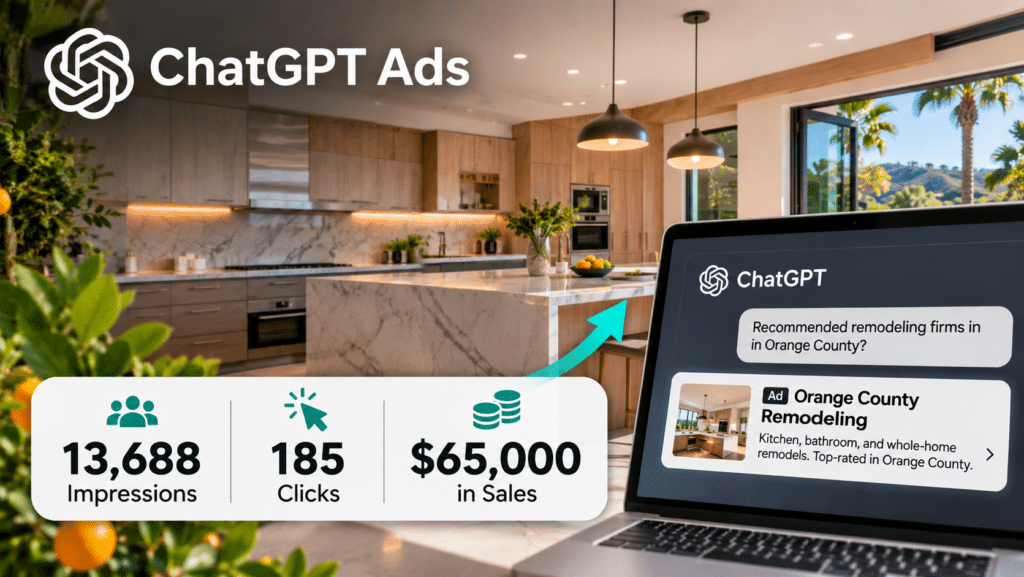
In its first month on ChatGPT ads, an Orange County design-build remodeler spent $1,296 and won a client who signed a paid Design Agreement for a project estimated at $65,000. Server-side tracking tied that client back to a single ad: Kitchen ad K3, clicked on 4 Oct 2026.
At a glance
| Metric | October 2026 (2 to 30 Oct) |
|---|---|
| Ad spend | $1,296 (43% of a $3,000 plan) |
| Impressions | 13,688 |
| Clicks | 185 |
| Click-through rate | 1.35%, against a US ChatGPT ads average of about 0.73% |
| Cost per click | $7.01 |
| Tracked leads | 1 |
| Signed Design Agreements | 1, on a project estimated at $65,000 |

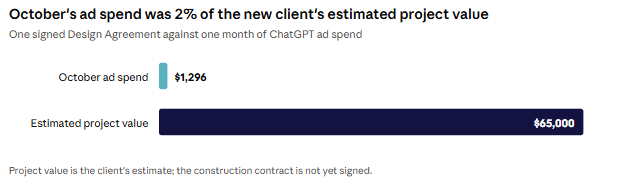
One deal shows the channel can produce a real buyer. It does not yet show that it does so reliably, and the case study treats it that way.
The client and the challenge
The client is a design-build remodeling firm in Orange County, California, selling kitchen, bathroom and whole-home projects. Its jobs are large and considered: homeowners research for weeks before they call anyone.
More of that research now happens inside ChatGPT. When ChatGPT ads opened to advertisers, the firm chose to test the channel early rather than wait for benchmarks. The question was simple: can a ChatGPT ad reach a homeowner mid-conversation and turn them into a paying client, and can we prove which ad did it?
Two things made that hard:
- No playbook. OpenAI publishes no official benchmarks, and ad approval rules for housing-related services were still being applied ad by ad.
- Attribution. A remodeling lead can take weeks to become a contract, so a click-level report alone cannot show whether the channel produced revenue.
Approach
Verity Marketing built three campaigns, one per service, each targeting 58 Orange County ZIP codes. Every campaign carried five ads, each testing a different angle, so the test covered 15 messages in all.
| Campaign | Daily budget | Angles tested |
|---|---|---|
| Kitchen | $40 | Trust, price certainty, process (3D design preview), open-plan, change orders |
| Whole home | $28 | One contract, scope, trust, remodel vs move, change orders |
| Bath | $30 | Spa bath, trust, aging in place, price and timeline, change orders |
Each campaign ran in two sets. The leads set launched on 2 Oct and bid for contact-form leads. The clicks set launched on 22 Oct, bid for clicks with an $8 cap, and had no lead goal. OpenAI rejected three ads (K1, W1, W4) in the clicks set under its housing rules, while approving the same ads in the leads set.
Tracking every lead to its source. Server-side tracking sent each contact-form conversion back to the ad platform and kept the ad, campaign and click date attached to the lead. That lets the team follow a lead past the form, through the client’s sales process, to a signed agreement. Conversions were credited using OpenAI’s default 30-day click window.
Results
October delivered 185 clicks at $7.01 each and one tracked lead that became a signed client. Click volume held at about 6 a day for most of the month, then rose to 11 a day from 28 to 30 Oct after the clicks set launched.

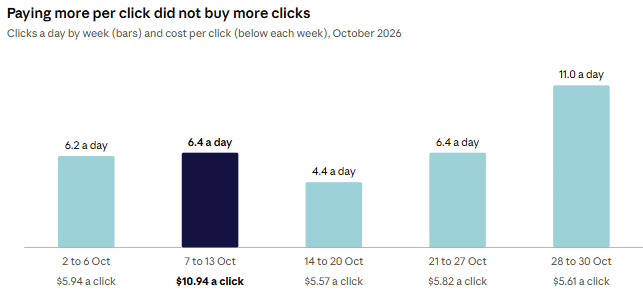
The costliest week bought the same 6.4 clicks a day as the cheaper weeks around it, so bidding up did not reach more people.

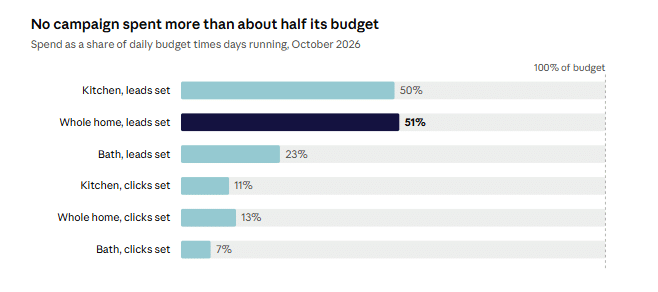
Budget was never the constraint. Even the busiest campaign used about half of what it was allowed, which is why the November plan steps budgets down.
Kitchen carried the account, taking nearly half the spend and producing the lead:
| Service | Spend | Share of spend | Clicks | Cost per click | Leads |
|---|---|---|---|---|---|
| Kitchen | $624 | 48% | 85 | $7.34 | 1 |
| Whole home | $450 | 35% | 65 | $6.93 | 0 |
| Bath | $222 | 17% | 35 | $6.33 | 0 |

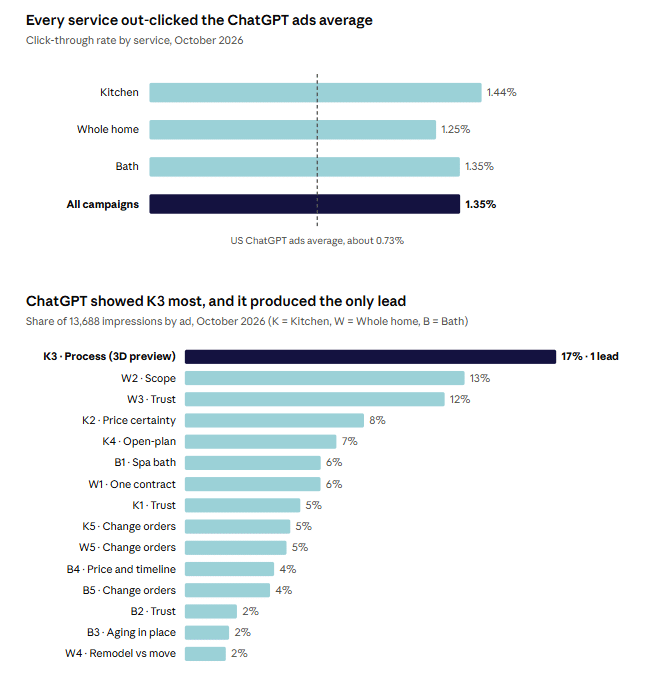
K3, which promised homeowners they could see the kitchen in 3D before building, got 17% of all impressions, more than any other ad.

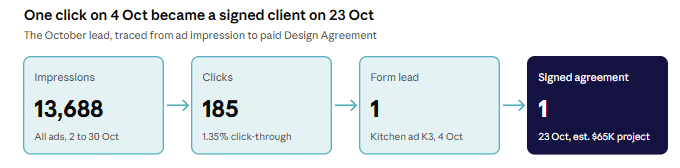
The homeowner who clicked K3 filled in the contact form on 4 Oct and picked “AI Search” as how they heard about the firm. The project turned out to be a primary bathroom, not a kitchen. Nineteen days later they signed a paid Design Agreement, and the construction contract is still to come.
Key insights
- People who see the ads click on them. A 1.35% click-through rate is close to double the roughly 0.73% US average reported for ChatGPT ads. The ads matched what people were already asking about.
- Volume, not budget, is the limit. No campaign used more than 51% of its daily budget, and total spend came in at 43% of plan. In a local market, only so many people have a matching ChatGPT conversation on a given day.
- Paying more did not buy more reach. The week of 7 to 13 Oct cost $10.94 a click, nearly double the other weeks, yet delivered the same 6.4 clicks a day.
- ChatGPT picks the winners. With 2 to 36 clicks per ad, click-through differences are still mostly chance. How often ChatGPT chooses to show an ad is the steadier signal, and K3 led on that measure.
- The channel reaches buyers who are ready to sign. The lead was a homeowner far enough along to sign a paid Design Agreement within 19 days of first contact.
- Attribution changes the story. On click data alone, October looks like a $1,296 test with one form fill. Following that lead to a signed agreement shows a client worth an estimated $65,000.
A caveat on that last point: one deal is a proof of possibility, not a rate. The firm needs several more months of data before judging cost per client.
What’s next
For November, Verity Marketing has proposed three changes, each pending the client’s approval:
- Right-size the budget. Step down to about $2,000 a month (roughly $65 a day), since October showed that more budget would not buy more clicks.
- Run one campaign set, not two. The leads and clicks sets compete for the same small pool of conversations. The team will pick one once late-October numbers settle.
- Trim the ad list. October reached the 150 to 200 clicks needed to judge ads. The keepers will be chosen mainly by how often ChatGPT shows each one.
For other local service businesses, the lesson is to set up lead-to-revenue tracking before launch. On a low-volume, high-ticket channel, the click report will undersell the result.
To see how we helped another firm 2.5X revenue in 5-years, click here>>